The tourbillon is one of the most remarkable features in the world of horology. This rotating cage of gears and springs, spinning gracefully within a watch’s heart, has long been a hallmark of haute horlogerie.
But what exactly makes it so revered? Is it a groundbreaking solution to the challenges of timekeeping, or merely a dazzling flourish for those who can afford it? As watch collectors and enthusiasts debate its true value, the tourbillon stands as a testament to human ingenuity and the allure of excess.
This exploration delves into its history, mechanics, and cultural significance to uncover whether it drives progress in watchmaking or simply elevates luxury to new heights.
The Origins of the Tourbillon
The story of the tourbillon begins in the late 18th century, a time when pocket watches dominated the landscape of personal timepieces. Abraham-Louis Breguet, the legendary Swiss watchmaker, is credited with inventing the tourbillon in 1795, though some historians point to earlier influences from English clockmakers.
Breguet’s motivation was practical. Pocket watches, often carried vertically in a vest pocket, suffered from gravitational inconsistencies. The Earth’s pull affected the balance wheel’s oscillation, leading to inaccuracies that could amount to several minutes per day. To combat this, Breguet devised a rotating frame that would average out these positional errors over time.
Breguet’s first tourbillon-equipped watch was commissioned by the French marine chronometrist Pierre Louis Moinet in 1814, but it remained a rarity. The mechanism was patented in 1801, yet its complexity limited widespread adoption.
It was not until the 19th century that the tourbillon gained traction among elite watchmakers. Louis Breguet, son of Abraham-Louis, refined the design, incorporating it into watches for royalty and nobility. By the mid-1800s, figures like Ferdinand Berthoud and Antide Janvier had experimented with similar concepts, but Breguet’s version set the standard.
The tourbillon’s early years were marked by its association with precision instruments for astronomers and navigators. In an era before quartz movements, where every second mattered for celestial calculations, this complication offered a marginal but meaningful edge. Its debut in wristwatches came much later, around the early 20th century, as the industry shifted from pockets to wrists. Today, the tourbillon evokes that pioneering spirit, reminding us of watchmaking’s roots in solving real-world problems.
How the Tourbillon Works
At its core, the tourbillon is a feat of micro-engineering designed to neutralize gravity’s influence on a mechanical watch’s escapement. The escapement, which includes the balance wheel and pallet fork, regulates the release of energy from the mainspring. In a static position, gravity can cause the balance to swing unevenly, slowing or speeding the rate.
Enter the tourbillon: a small, rotating cage, typically made of lightweight titanium or gold, houses the escapement and balance. This assembly completes one full revolution every minute, exposing it to all vertical positions equally. Over the course of that minute, any gravitational bias is mathematically averaged out, theoretically resulting in more consistent timekeeping. The cage is driven by the watch’s own power source, adding no extra energy but requiring exquisite balance to avoid draining the mainspring.
Modern iterations have evolved beyond Breguet’s original single-axis design. Flying tourbillons, where the cage appears suspended without visible pivots, offer a sleeker aesthetic. Multi-axis versions, like those rotating on two or three planes, further complicate the mechanics to address horizontal gravity effects, though these are rarer and more expensive. Silicon components, introduced in the 21st century, have lightened the cage and reduced friction, enhancing efficiency.
Understanding the tourbillon requires appreciating its subtlety. It does not make a watch “perfectly” accurate; modern lubricants and materials have rendered its benefits negligible in wristwatches, which spend most time in fewer positions. Yet, its hypnotic motion, visible through sapphire casebacks, turns a functional fix into a visual spectacle.
The Case for Innovation
Proponents of the tourbillon argue it embodies the relentless pursuit of perfection in watchmaking. In Breguet’s time, it was revolutionary, pushing the boundaries of what mechanical timepieces could achieve. Even today, crafting a tourbillon demands unparalleled skill. Assembling the 30 to 50 tiny parts involves hand-finishing bridges, polishing jewels, and calibrating springs to tolerances of microns. This labor-intensive process, often taking hundreds of hours, fosters innovation in materials and techniques.
Take, for instance, the integration of new alloys and anti-magnetic properties. Brands have used the tourbillon as a testing ground for advancements like the silicon escape wheel, which resists temperature changes and magnetism far better than traditional metals. These spillover effects benefit simpler watches, democratizing high-end tech. Moreover, in an age of smartwatches, the tourbillon reaffirms mechanical horology’s relevance by showcasing what electronics cannot replicate: artisanal complexity.
Critics might dismiss it as outdated, but data suggests otherwise. Independent tests, such as those by the Glashütte Observatory, have shown tourbillon-equipped watches achieving chronometer-level accuracy, sometimes surpassing standards. For collectors, it represents evolution. The mechanism has inspired hybrid complications, like the tourbillon chronograph, blending timing functions with rotation for enhanced readability. In essence, the tourbillon is not just a relic; it is a catalyst for pushing horological frontiers.
The Luxury Perspective
On the flip side, detractors view the tourbillon as the ultimate status symbol, a luxury indulgence divorced from practicality. Prices for tourbillon watches often start at $50,000 and climb into the millions, driven not by utility but by scarcity and prestige. The complication adds little measurable accuracy to modern wristwatches, where shock-resistant balances and refined hairsprings suffice. In vertical positions, like on a nightstand, it shines, but during daily wear, the benefit evaporates.
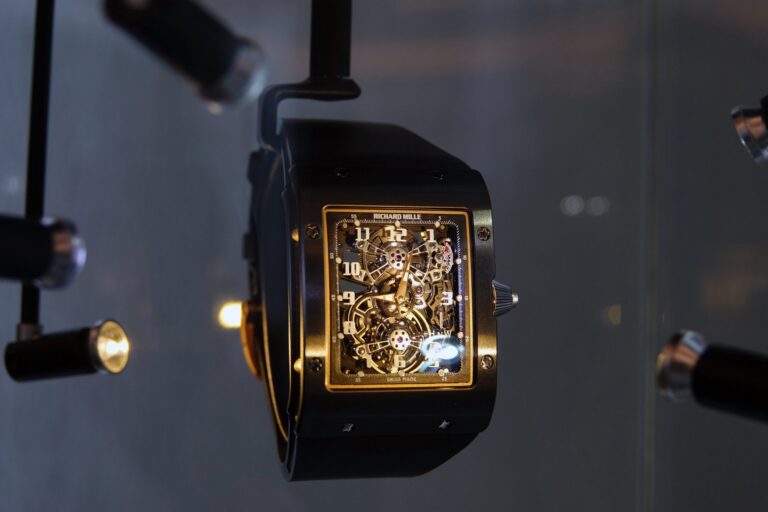
This raises questions about value. Why pay a premium for a feature that, in Breguet’s era, addressed pocket watch woes but now serves more as eye candy? The rotating cage, often skeletonized and jeweled, becomes the star of open-heart dials, mesmerizing buyers with its ballet-like spin. Marketing amplifies this, positioning tourbillons as heirlooms for the elite. Brands like Richard Mille integrate them into avant-garde designs, where the mechanism’s form overshadows function.
Yet, this exclusivity fuels the luxury market. Tourbillons account for a niche but growing segment, with the global market projected to expand at a 5% CAGR through 2030, buoyed by Asian demand. They symbolize connoisseurship, much like a fine wine’s vintage. For some, the “waste” of resources on such intricacy is the point: it celebrates craftsmanship over commodification. Still, in a world of accessible quartz, the tourbillon risks alienating newcomers, reinforcing horology’s image as an old boys’ club.
Iconic Tourbillon Watches
No discussion of tourbillons would be complete without spotlighting masterpieces that define the category. Breguet’s own Classique Tradition 7067, with its flying tourbillon and guilloché dial, pays homage to the inventor’s legacy at around $100,000. It features a platinum case and a mechanism visible from both sides, blending heritage with transparency.
Audemars Piguet’s Royal Oak Concept Flying Tourbillon captures modern flair. Introduced in 2018, this titanium beast integrates the complication into the brand’s iconic octagonal bezel, priced over $150,000. Its openworked dial reveals a black-coated movement, emphasizing industrial innovation.
Patek Philippe’s Grandmaster Chime Ref. 6300A, a 2014 limited edition, stands as a tour de force with 20 complications, including a minute repeater and perpetual calendar alongside the tourbillon. Auctioned for $31 million in 2019, it exemplifies how tourbillons anchor ultra-complicated pieces.
For accessibility, Frederique Constant’s Manufacture Classic Tourbillon offers an entry at under $10,000, proving the complication need not be stratospheric. Vacheron Constantin’s Overseas Tourbillon Skeleton, with its sporty rubber strap, merges luxury and wearability.
These examples illustrate the spectrum: from timeless elegance to bold experimentation, each tourbillon tells a story of brand identity.
Modern Developments and Future Prospects
The tourbillon’s evolution continues unabated, adapting to contemporary tastes. Recent advancements include multi-axis designs, like Greubel Forsey’s Quadruple Tourbillon, which tilts on four axes for theoretical ultra-precision. Brands experiment with 3D printing for lighter cages and AI-assisted assembly for tighter tolerances.
Sustainability enters the fray too. Eco-friendly materials, such as recycled gold, appear in tourbillon cases, aligning luxury with ethics. Collaborations with tech firms yield hybrid models, embedding NFC chips for authenticity verification without compromising mechanics.
Looking ahead, the tourbillon may find new life in smart-mechanical hybrids, where rotation powers micro-generators for always-on displays. Market trends point to growth in emerging economies, where affluent buyers seek cultural cachet. Yet, challenges loom: rising material costs and skilled labor shortages could inflate prices further.
Ultimately, the tourbillon’s future hinges on balancing tradition with relevance. As watchmaking grapples with digital disruption, this complication could anchor the industry’s soul, proving that true innovation often wears the guise of timeless beauty.
The Enigma That Keeps Turning
So, is the tourbillon an innovation or mere luxury? The answer lies in perspective. For the engineer, it is a brilliant hack against nature’s forces, sparking decades of refinement. For the collector, it is opulence incarnate, a whirlwind of artistry justifying its cost through sheer wonder. In truth, it is both, intertwined in a dance as elegant as the mechanism itself.
Whether you see it as a practical marvel or extravagant flourish, the tourbillon endures as horology’s enduring enigma, inviting us to ponder the fine line between necessity and desire. As the watch world spins forward, one thing remains certain: this rotating cage will continue to captivate, one revolution at a time.