There are automatic tourbillons, and then there are automatic tourbillons you actually want to wear every day. Standing in the Girard-Perregaux presentation suite in Geneva this week, the brand’s product team made a quiet but telling point: the new Laureato Fifty Tourbillon Micro-Rotor 39mm is not another showcase piece destined for a safe. It is a production watch, built to be worn, and at 39mm by 10mm it might be the most wearable flying tourbillon the Maison has ever put into steel.
The timing matters. The Laureato turned fifty last year, and Girard-Perregaux has spent 2026 converting its anniversary celebration into a permanent pillar of the collection. The Fifty family launched with the self-winding Calibre GP4800 models — 39mm and 36mm, blue Grand Feu enamel, 18k gold dials and a diamond-set silver option — and now the tourbillon steps up as the flagship. This is the complication the whole architecture was waiting for: the octagonal bezel, the tonneau case flowing into an integrated bracelet, and an in-house calibre designed from a blank sheet rather than adapted from something older.
Five Signatures, One Case
Girard-Perregaux likes to say the Fifty Tourbillon unites five enduring signatures of the Manufacture, and seeing it in the metal, the claim holds up. There is the Laureato case itself, born in 1975 at the height of the integrated-bracelet era. There is the Clous de Paris hobnail texture, stamped into the dial and repeated on the two white-gold decorative plates visible through the caseback. There is the Grand Feu enamel work, which GP traces back to Jean-François Bautte’s Geneva workshops of the 1790s. And there are the two structural signatures of the movement: the arrow-shaped bridge, a motif Constant Girard first used in 1867, and the lyre-shaped tourbillon cage, which has been part of the Maison’s visual language since the 19th century.
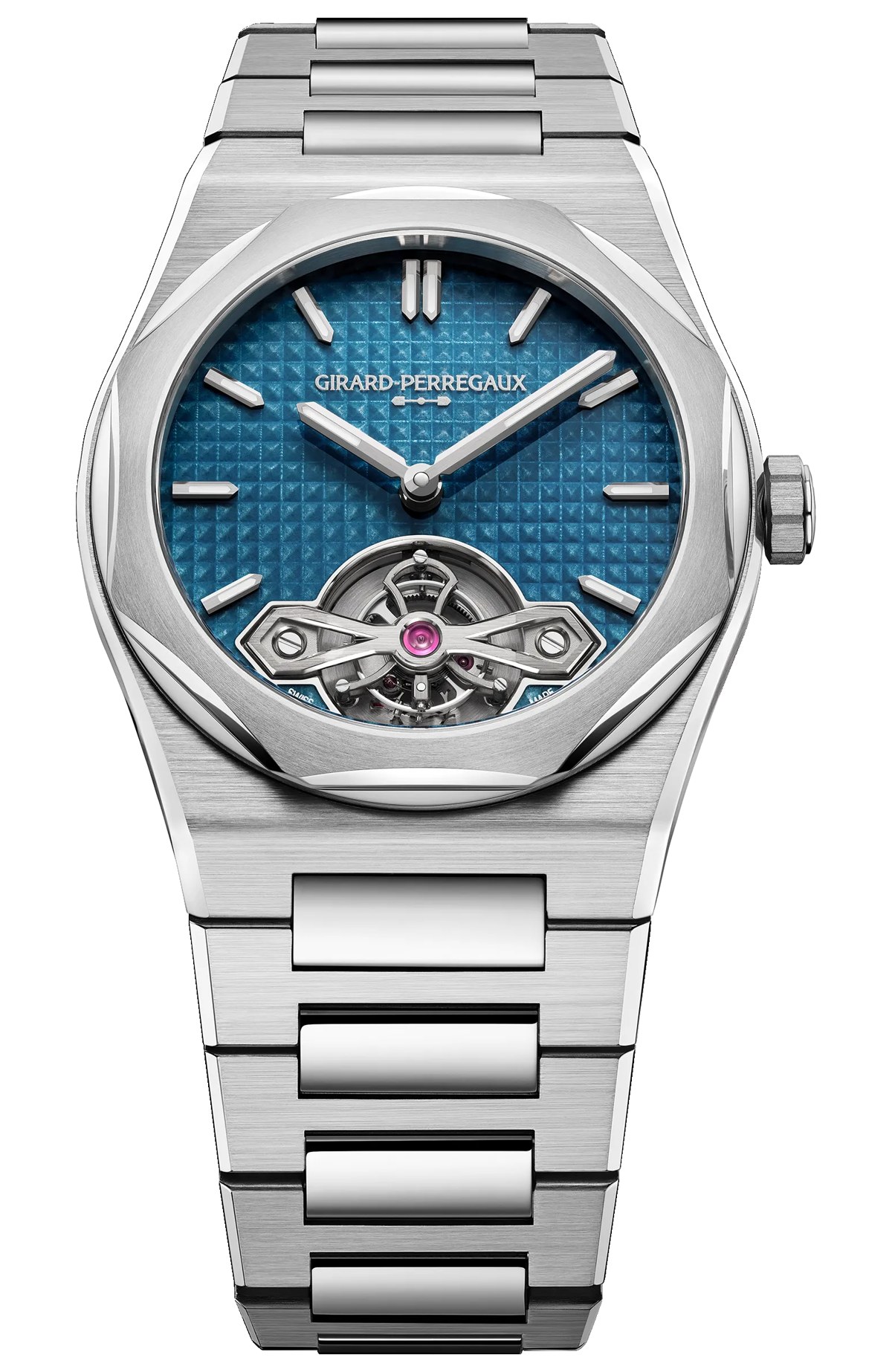
That the whole composition lands at just 10mm thick is the real achievement. A flying tourbillon usually demands depth; the GP8410 tucks it into a movement measuring 30.40mm across and a mere 6.10mm tall. The dial-side effect is a tourbillon at five o’clock that cuts directly into the repeating hobnail pattern — there is no separate sub-dial, no recessed well. Just the cage, the blue enamel, and a lot of light.
Calibre GP8410: A Micro-Rotor Built for Views
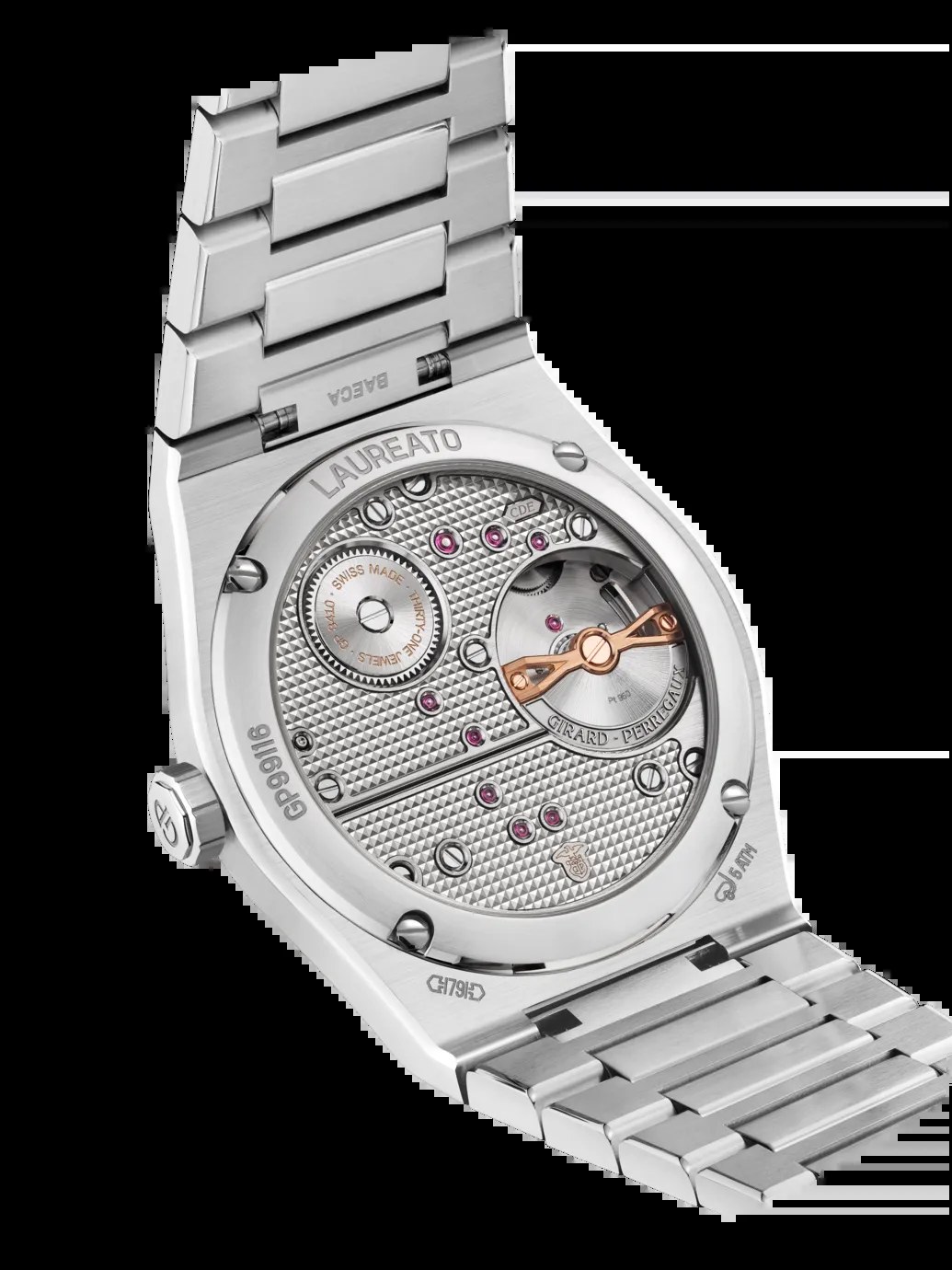
The new in-house calibre is the fourth fresh GP movement in twelve months, following the GP4800, GP9620 and GP9530. Its signature trick is the oscillating weight — a platinum and pink gold micro-rotor shaped as a slender arrow, parked off to one side so the bridgework can breathe. Girard-Perregaux has given it a noise-reduction system, a small touch that speaks to how seriously the brand takes the everyday-wear brief.
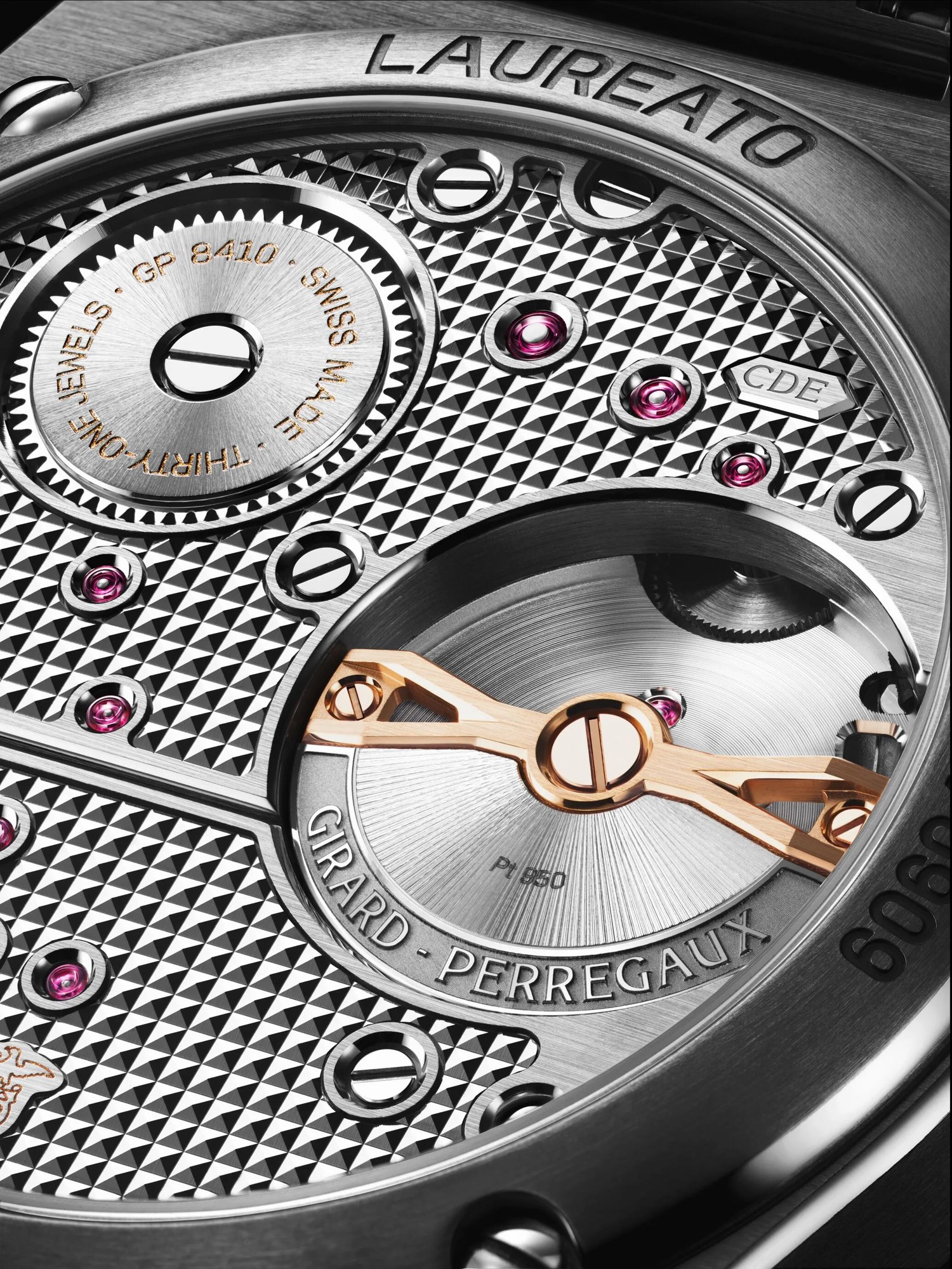
Under the sapphire back, the finishing runs deep. Sandblasting, drawn strokes, bevelling and satin finishing are distributed across the plates, while the two large white-gold bridges carry the same Clous de Paris pattern as the dial and receive a diamond-polished finish. The tourbillon beats at 21,600 vibrations per hour — the classic slow, theatrical beat — and the mainspring holds 72 hours, which is genuinely useful for a watch this thin. Power, by the way, arrives through a self-winding system only: there is no hand-winding crown position to fall back on.
The Dial Debate: Blue Enamel vs 18k Gold
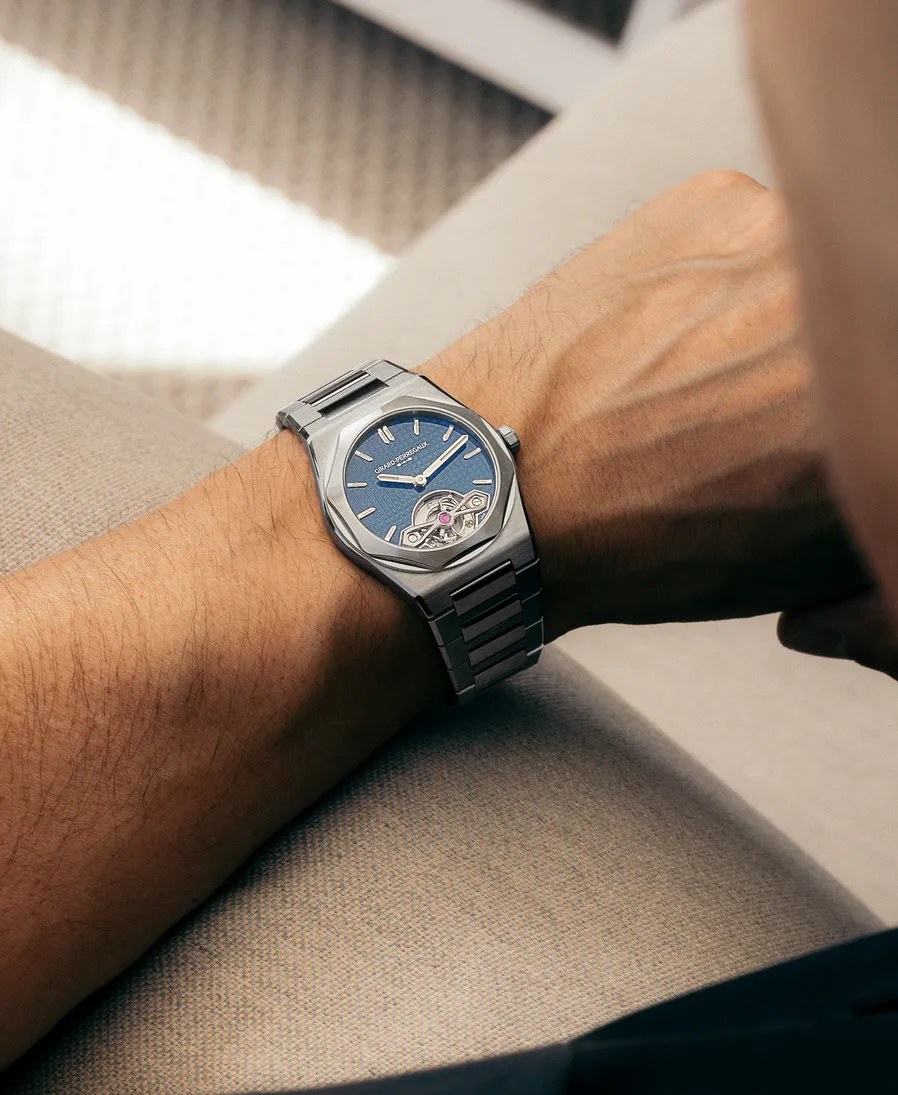
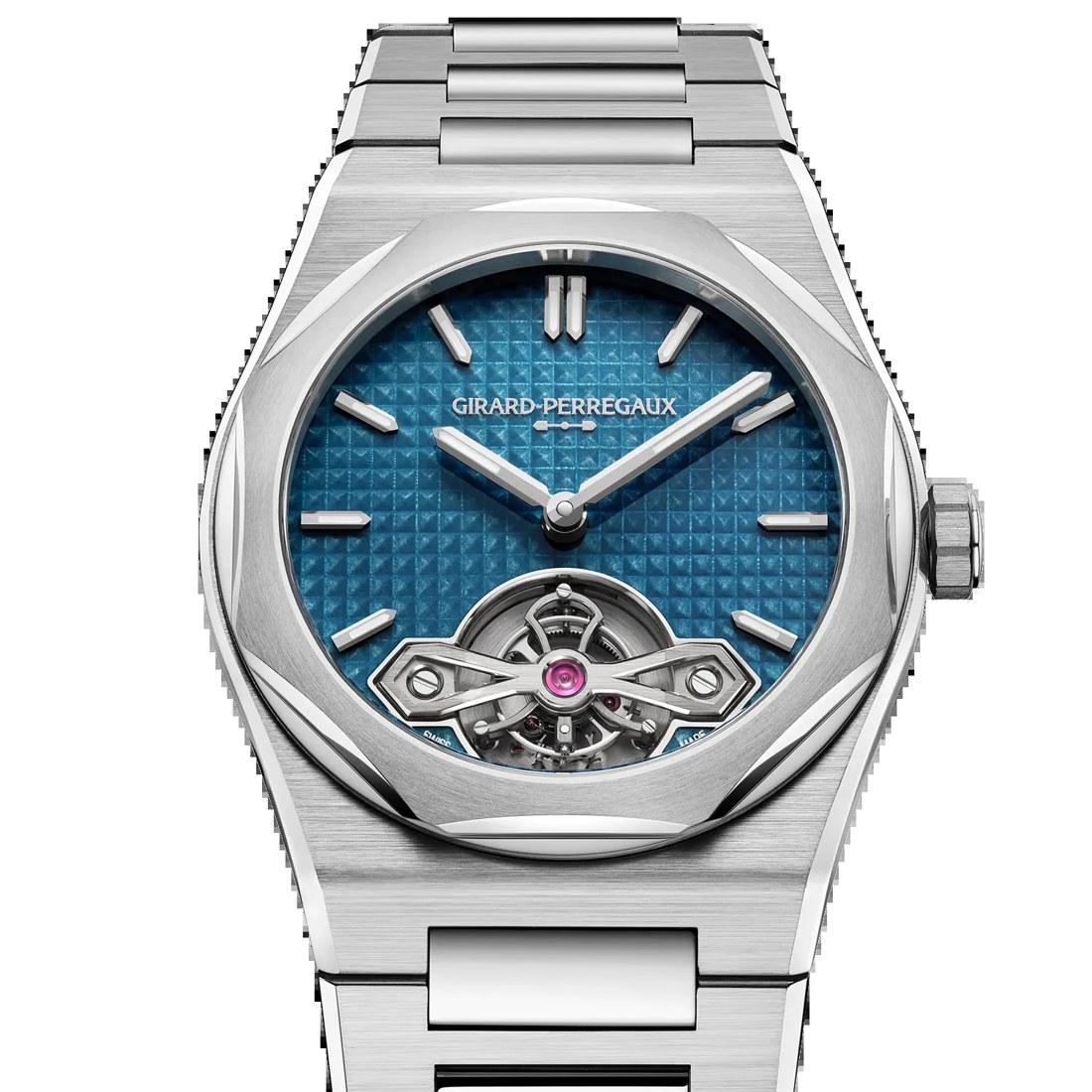
Two dial options launch the line, and they could not feel more different. The blue version is the headliner: a white-gold base stamped with Clous de Paris, then covered with translucent Grand Feu enamel fired entirely in-house. Enamel has a way of swallowing light and giving it back at a different wavelength, and over a textured base it becomes almost three-dimensional. On the wrist it shifts from petrol blue to deep navy depending on the angle.
The alternative is an 18k solid gold dial with the same hobnail texture, warm and unapologetically rich in tone. Both use white-gold baton hands and applied indexes loaded with blue-emitting lume, and both keep the dial layout perfectly symmetrical around that five o’clock cage. If the enamel is the showpiece for light, the gold dial is the one that reads as pure jewelry — and at these prices, either is a statement.
Specifications
| Reference | 99116-11-3528-1CM (blue enamel); 18k gold dial variant also available |
|---|---|
| Case | Stainless steel, 39mm diameter, 10mm thick |
| Bezel | Octagonal, polished and satin-finished, integrated into case |
| Crystal | Sapphire, front and back, anti-reflective |
| Caseback | Sapphire crystal, screw-on, display |
| Water Resistance | 50 metres |
| Movement | Calibre GP8410, in-house, self-winding mechanical |
| Functions | Hours, minutes, small seconds on tourbillon |
| Tourbillon | Flying tourbillon, lyre-shaped cage, arrow-shaped bridge |
| Oscillating Weight | Platinum and pink gold micro-rotor with noise-reduction system |
| Frequency | 21,600 vph (3 Hz) |
| Power Reserve | 72 hours |
| Components / Jewels | 207 components, 31 jewels; 30.40mm x 6.10mm |
| Dial | Blue Grand Feu enamel over Clous de Paris, or 18k solid gold with Clous de Paris; white-gold baton hands and indexes, blue lume |
| Bracelet | Integrated stainless steel, triple folding clasp with micro-adjustment system |
| Price | US$100,000 (blue enamel); US$95,600 (18k gold dial) |
Availability and First Impressions
The Laureato Fifty Tourbillon Micro-Rotor 39mm is available now at Girard-Perregaux boutiques and authorized retailers, and it is not a numbered limited edition — the brand is explicit that craftsmanship, not scarcity, defines it. The steel case, the 50-metre rating and the integrated bracelet with its on-the-fly micro-adjustment clasp all point one direction: this is a high-complication watch engineered for rotation on the wrist, not a glass-case trophy.
After a week of Geneva launches, this is the one I kept coming back to. The integrated sports watch is the most crowded arena in horology, but very few brands can drop a flying tourbillon into a 10mm steel case with a Grand Feu enamel dial and still call the result an everyday proposition. Girard-Perregaux just did — and the Laureato, five decades in, has a new reason to stay on your wrist.