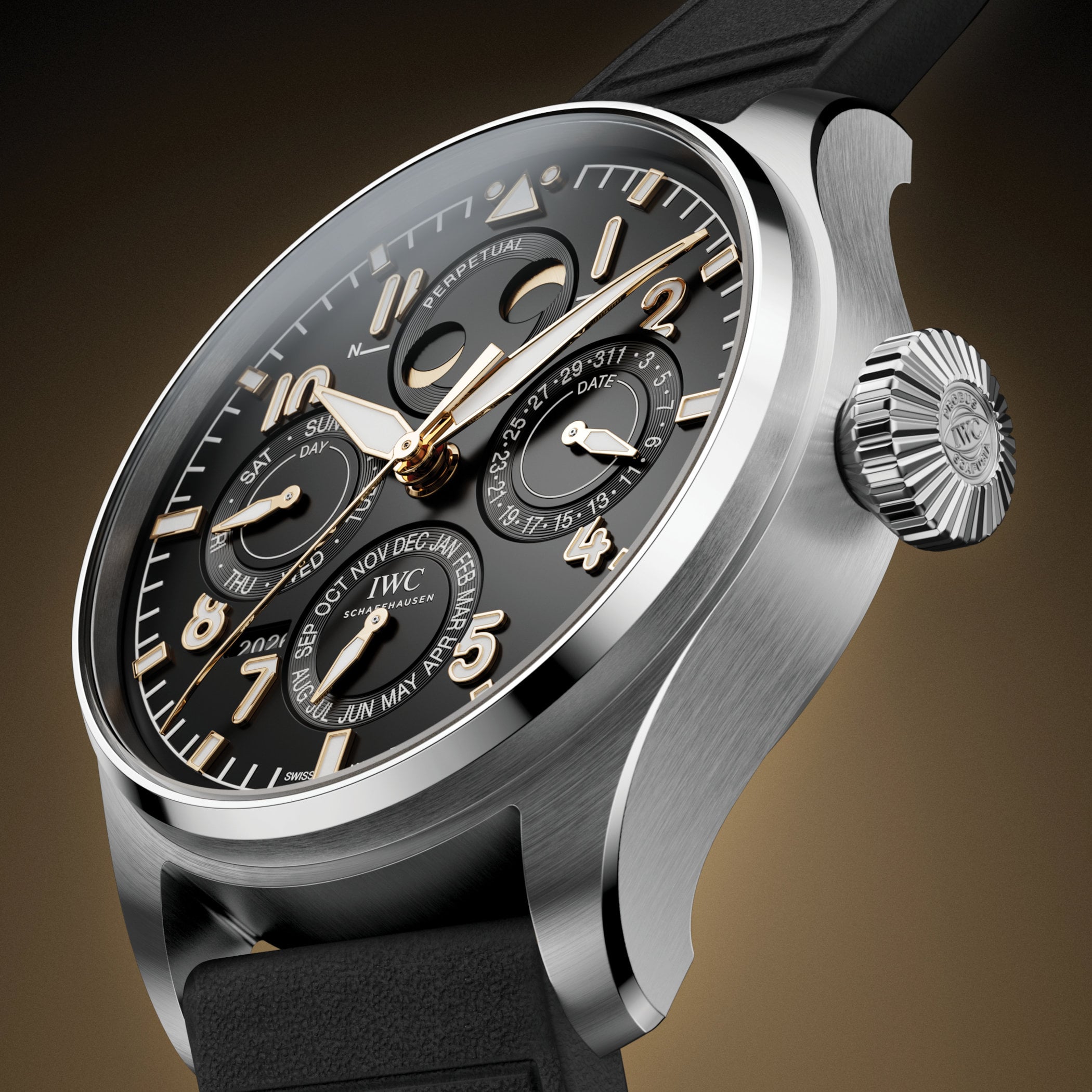
IWC Big Pilot Perpetual Calendar ProSet 140 Years Mercedes-Benz in Steel and Gold
IWC Schaffhausen has opened a new chapter in its long-running partnership with Mercedes-Benz. The two companies go back decades, and their collaborations have covered everything from Formula 1 special editions to road-car inspired dress watches. Now, to mark 140 years since the founding of the Stuttgart marque, IWC has released the Big Pilot Perpetual Calendar ProSet 140 Years Mercedes-Benz, a 42mm steel limited edition that pairs the brand’s most approachable perpetual calendar technology with a black and gold presentation.
Only 140 pieces will be made, one for each year of Mercedes-Benz history, and the watch is priced at EUR 40,900 including VAT. That places it above the standard steel Big Pilot Perpetual Calendar ProSet introduced earlier in 2026, with the premium justified by the gold detailing on the dial and the anniversary exclusivity. The reference is IW3296-03.
What makes this release genuinely interesting is not the decoration, but the mechanism beneath it. The Big Pilot Perpetual Calendar ProSet 140 Years Mercedes-Benz carries IWC’s ProSet calendar system, a design that lets the wearer set every calendar indication through the crown alone. No hidden correctors, no stylus, no guesswork about which pusher does what. It is a meaningful step toward making the perpetual calendar a practical everyday complication rather than a collector’s curiosity, and it deserves a closer look.
Why the ProSet Calendar Matters
Traditional perpetual calendars are wonderful to look at and occasionally infuriating to adjust. Setting the date, day, month and moon phase usually means pressing tiny correctors recessed into the case band, often with a dedicated tool, and always with a printed guide to hand. IWC’s ProSet system removes that friction entirely. All calendar functions are set through a single crown position, and the mechanism can be adjusted both forwards and backwards, which matters when a watch has sat unwound for a few weeks and the calendar needs to be pulled back to the correct day.
The system works through a stacked program wheel that centralises the calendar information. The assembly contains roughly twenty parts, including a leap year wheel with retractable fingers that handles the irregular length of February. Because the mechanism is entirely gear based, there are no fragile levers to snap and no springs to lose. The calibre 82665 used here is the Big Pilot version of the ProSet architecture that IWC introduced in the calibre 82655.
Precision is part of the package too. The moon phase display, shown through a Double Moon aperture at 12 o’clock that tracks both hemispheres, is accurate to a single day of error in 1,040 years. The date, day, month and a four digit yea
r window complete the calendar layout, with the year reading between 7 and 8 o’clock in typical Big Pilot fashion.
Design and Dial
The case is stainless steel, brushed across the sides with a polished bezel, and it houses the oversized diamond shaped crown that has identified the Big Pilot since the 1940s. With the ProSet mechanism, that crown does more work than any previous Big Pilot crown, which feels appropriate for a watch designed around practicality.
The dial is glossy black with a sunburst finish, and the applied hour markers are solid gold while the hands are gold plated. Both carry Super-LumiNova for night legibility. The gold on black combination is a deliberate nod to the luxury end of the Mercedes-Benz range, closer in spirit to a Maybach interior than to the racing liveries of the AMG PETRONAS Formula 1 team. Four recessed subdials hold the calendar indications, and the layout is immediately recognisable as a modern IWC perpetual calendar.
Water resistance is rated to 100 metres, unusually generous for a perpetual calendar and a reminder that this is a pilot’s watch first. The sapphire caseback reveals the movement and carries an engraving of the historic joint emblem adopted after t
he 1926 merger of Daimler-Motoren-Gesellschaft and Benz & Cie, a subtle but fitting anniversary touch. The watch is delivered on a black rubber strap with a folding clasp and IWC’s EasX-CHANGE system, so the strap can be swapped without tools.
Inside the Calibre 82665
Power comes from the IWC manufacture calibre 82665, an automatic movement beating at 28,800 vibrations per hour. It uses IWC’s Pellaton winding system, the bidirectional mechanism that converts the rotor’s motion in both directions into winding energy through a pawl and ratchet arrangement, and the components are ceramic coated to resist wear. The stated power reserve is approximately 60 hours, enough to cover a long weekend off the wrist.
The Pellaton system has been a house signature since the 1950s, when Albert Pellaton designed it for IWC’s pocket watch movements. Its efficiency is one reason IWC automatics have such a robust reputation, and it pairs naturally with a calendar that the wearer can reset quickly after the reserve runs down. For a fuller picture of how rotors feed automatic movements, our guide to the automatic watch rotor covers the fundamentals, while our explainer on power reserve looks at what those 60 hours actually mean in daily use.
Specifications
| Reference | IW3296-03 |
|---|---|
| Case | Stainless steel, 42mm diameter, 14mm thick |
| Crystal | Convex sapphire, anti-reflective coating on both sides |
| Caseback | Sapphire crystal |
| Water Resistance | 100 metres |
| Dial | Glossy black sunburst, solid gold applied markers, gold-plated hands with Super-LumiNova |
| Calendar | Double Moon phase at 12, date at 3, month at 6, day at 9, four-digit year between 7 and 8 |
| Movement | Calibre 82665 automatic, 28,800 vph, Pellaton winding with ceramic components |
| Power Reserve | Approximately 60 hours |
| Strap | Black rubber with folding clasp, EasX-CHANGE system |
| Edition | Limited to 140 pieces |
| Price | EUR 40,900 including VAT |
Positioning and Context
The 140 Years Mercedes-Benz edition joins a small ProSet family that already includes the steel and red gold Big Pilot references launched earlier this year, together with the Le Petit Prince version. Those watches established the crown set architecture, and this anniversary edition extends the family into a more decorative register while keeping the same 42mm platform. For anyone weighing a modern perpetual calendar, the ProSet system is the easiest entry point in IWC’s catalogue, and the black and gold treatment gives this particular run a distinct identity that the standard models do not share.
It also reinforces how far the perpetual calendar has travelled from its origins as a showcase complication. A complication that once required a jeweller’s visit to adjust is now a crown turn away, and IWC deserves credit for pushing that idea into its most iconic collection. Our history of IWC Schaffhausen traces how the brand arrived at this point, and our overview of watch complications explains where the perpetual calendar sits in the wider horological landscape.
The IWC Big Pilot Perpetual Calendar ProSet 140 Years Mercedes-Benz is available from IWC boutiques and authorised retailers, and given the 140 piece run, allocation is likely to be swift. It is an anniversary watch with a genuine mechanical story, and that combination is rarer than it should be.