There is a moment at every Louis Vuitton watch presentation when the lights drop and the Spin Time cubes click over in sequence, and I have to admit it still gets me every time. This morning in the brand’s atelier, with Michel Navas and Matthieu Hegi of La Fabrique du Temps on hand, Louis Vuitton confirmed that the jumping-hour display it first introduced in 2009 is no longer a limited-edition party trick. The Tambour Spin Time is now a permanent collection, and the brand is launching it with five references that span a khaki-green daily wearer in white gold, a gem-set opal showpiece, and a platinum openworked flying tourbillon at the top of the range. It joins a busy September for jumping-hour news — De Bethune brought its own take on the display back just yesterday.
The Spin Time was born from a distinctly Parisian idea: twelve rotating cubes orbiting the dial, each flipped by a mechanism under the dial the way an airport departures board flips its flaps. Navas and his then-partner Enrico Barbasini conceived it around 2007, before Louis Vuitton owned La Fabrique du Temps outright, and the complication has remained one of the maison’s most recognisable horological signatures ever since. What launched in 2025 as a batch of Tambour Taiko Spin Time limited editions now returns as the backbone of the permanent line, in a case that carries over the Taiko’s drum-shaped silhouette, sculpted lugs and a bezel engraved with the twelve letters of the maison’s name.
Tambour Spin Time Green: The Entry Point
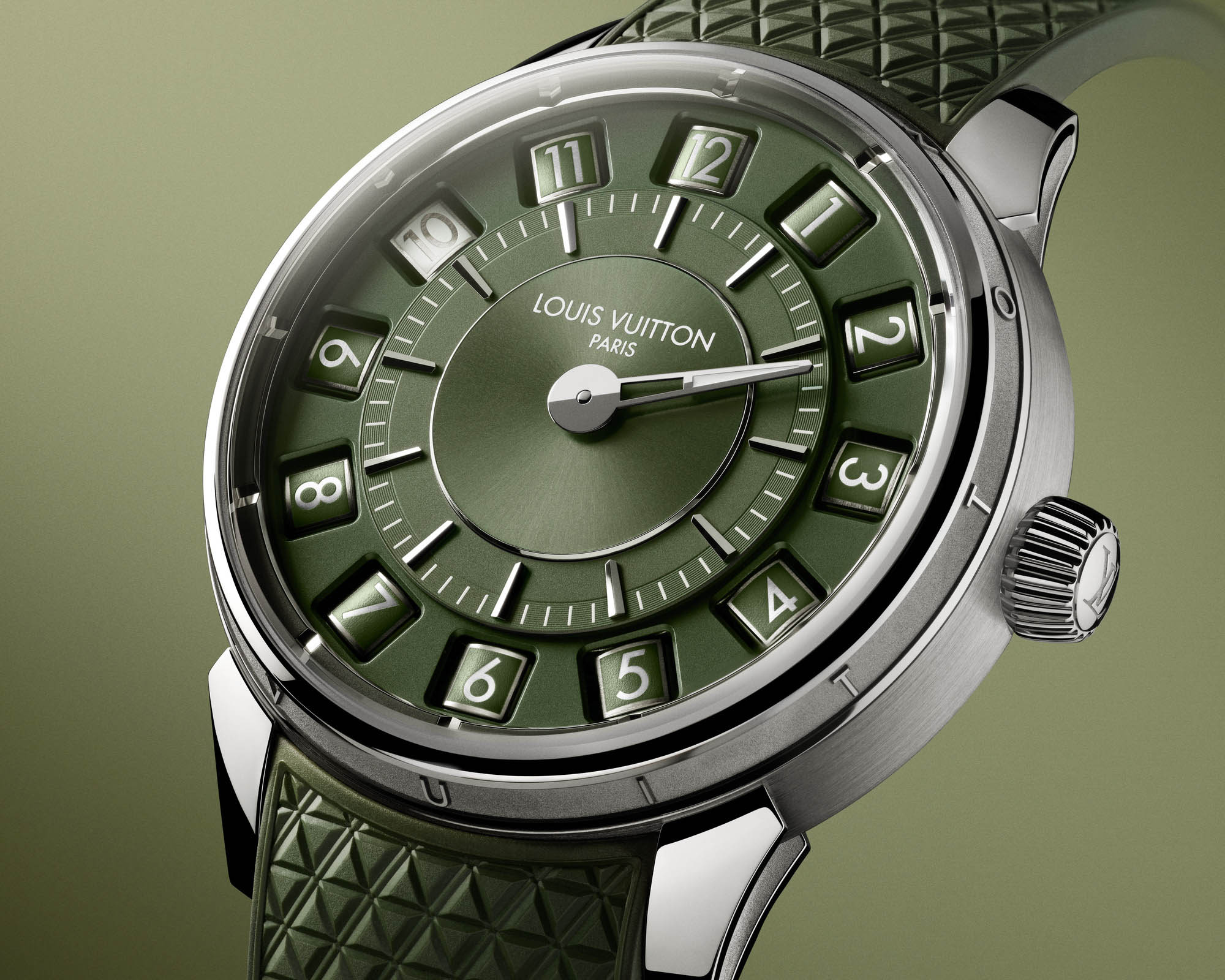
The watch most guests went straight for was the Tambour Spin Time Green, and it is easy to understand why. It is the most compact of the five at 39.5mm by 12.15mm, it is water resistant to 100 metres, and it wears the collection’s most restrained palette: a khaki-green dial with sunray and sandblasted surfaces, white gold markers and hands, and a tone-on-tone green rubber strap. At 18k white gold and USD 85,500 it is the natural everyday pick, the kind of watch you could wear to a studio session in the morning and a dinner in the Marais at night.
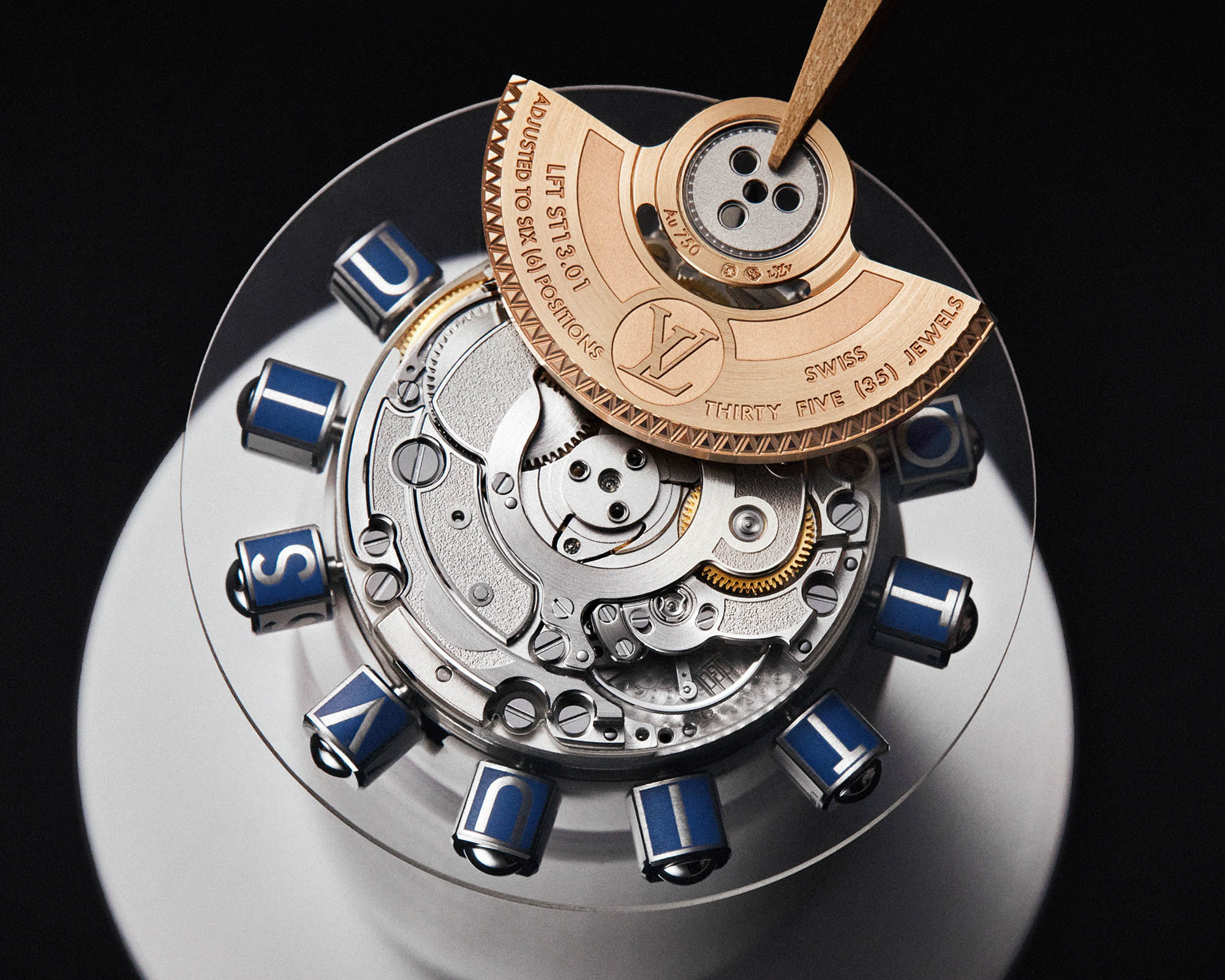
Under the sapphire caseback sits the calibre ST13.01, the new in-house automatic that Louis Vuitton’s watchmakers developed at La Fabrique du Temps. It beats at 4Hz with a 45-hour power reserve, and this year it is paired with a solid gold rotor, micro-blasted bridges, polished chamfers and colourless jewels. The big change from the 2025 limited editions is the display back: this time you get to watch the mechanism work. Like every member of the family, the ST13.01 drives the cubes through a jumping mechanism that flips the outgoing hour and the incoming hour simultaneously at the top of each hour, with a conventional central minute hand sweeping the outside.
Tambour Spin Time Australia’s Opal: Gem-Set Grandeur
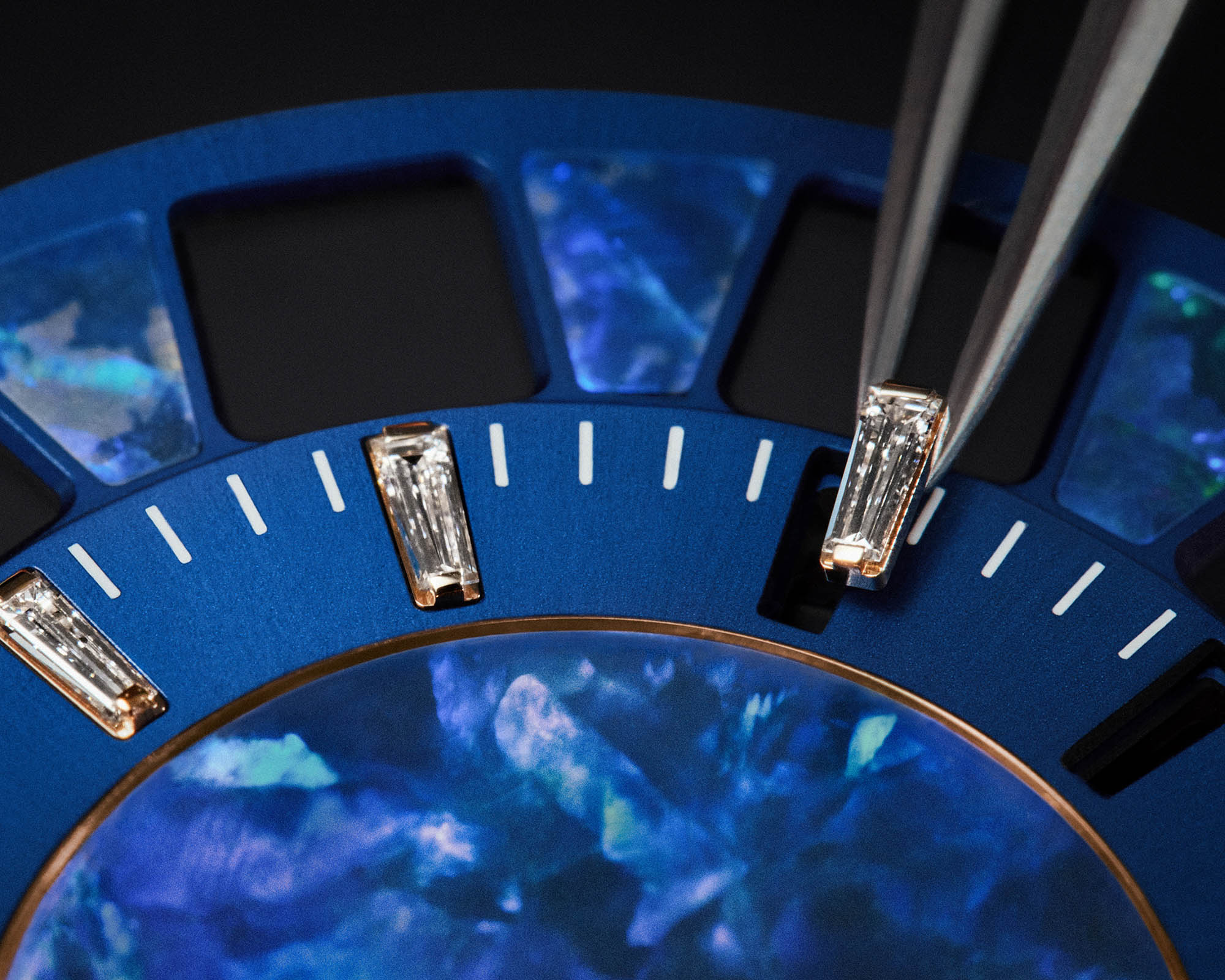
The second 39.5mm reference is the one that stopped the room. The Tambour Spin Time Australia’s Opal is Louis Vuitton’s first rose gold Spin Time, and it is effectively a jewellery piece with a jumping hour inside. The 18k rose gold case is set with baguette-cut blue sapphires across the bezel and lugs, and the dial is cut from Australian opal that shifts between indigo, teal and cerulean depending on the light. Louis Vuitton has set the opal both in the dial centre and between each of the twelve cubes, with baguette-cut diamonds marking the hours on a blue ring. At USD 189,000 it is priced as the collection’s gem-set statement, and it lives on a blue rubber strap with a matching rose gold buckle.
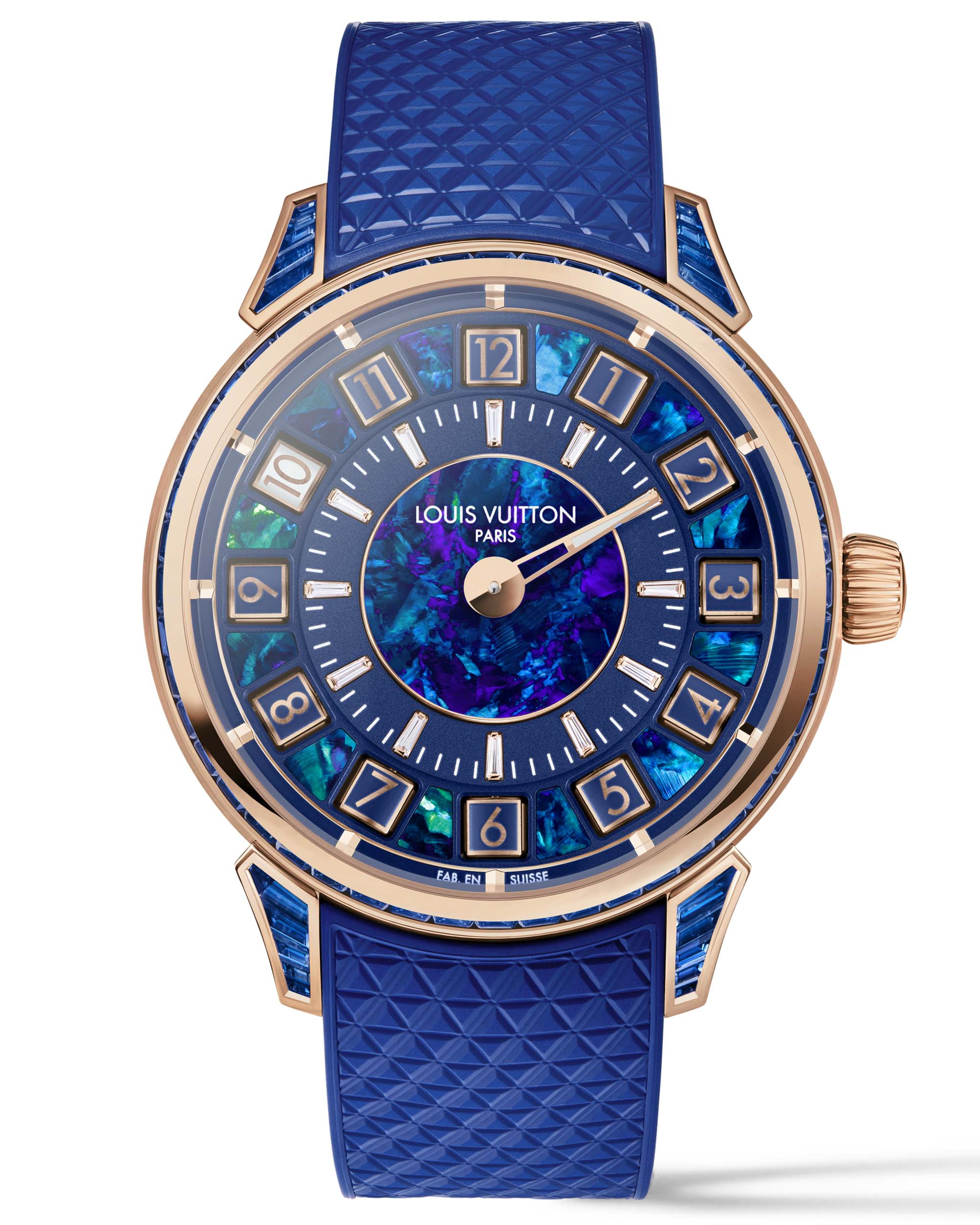
What impresses about the Opal is the restraint. Gem-set Spin Time watches can easily tip into overload, but the dark blue and silver-toned cubes with rose gold numerals keep the dial legible against the fire of the opal. It is a fine balancing act, and one that La Fabrique du Temps’s dial makers at La Fabrique des Cadrans have pulled off cleanly. The opal slices remain the hero; the diamonds and sapphires frame them rather than fight them.
The Spin Time Air Family: Openworked, Levitating Cubes
Move up to the openworked Air models and the architecture changes entirely. These are 42.5mm by 12.45mm, built around a central movement with the twelve cubes suspended around it like satellites, each dome-topped cube topped with a tiny polished stud that echoes the rivets on a Louis Vuitton trunk. The more complex case construction takes water resistance down to 50 metres, but the trade-off is a dial you can see through, with the mechanics of the jump mechanism visible at work.
The Tambour Spin Time Air Blue is the entry to the openworked part of the range at USD 94,500, and it swaps last year’s dolphin grey for a saturated blue that runs across the central dial, the cubes, the outer flange and the calf leather strap. In a clever nod to the maison’s trunk-making heritage, the cube faces on this edition spell out the letters of the Louis Vuitton name, with the letter for the current hour highlighted in a contrasting colour. It is a small detail, but it is the kind of thing that makes the Spin Time feel less like a complication and more like a piece of the brand’s travel soul.
Spin Time Air Antipode: A Worldtimer Built From Cubes
The Antipode is the most intellectually interesting of the five, because it inverts the entire concept. Instead of the cubes showing the local hour, the time at the centre is read conventionally — a rotating disc bearing a world map carries an arrowhead hour pointer in yellow, with a classic minute hand circling the flange. The twelve cubes become the world time display: each one carries two city names from opposite sides of the planet, exactly twelve time zones apart, so that when it is midnight in Los Angeles it is midday in Dubai, and the background of each cube tells you whether it is day or night in that city.
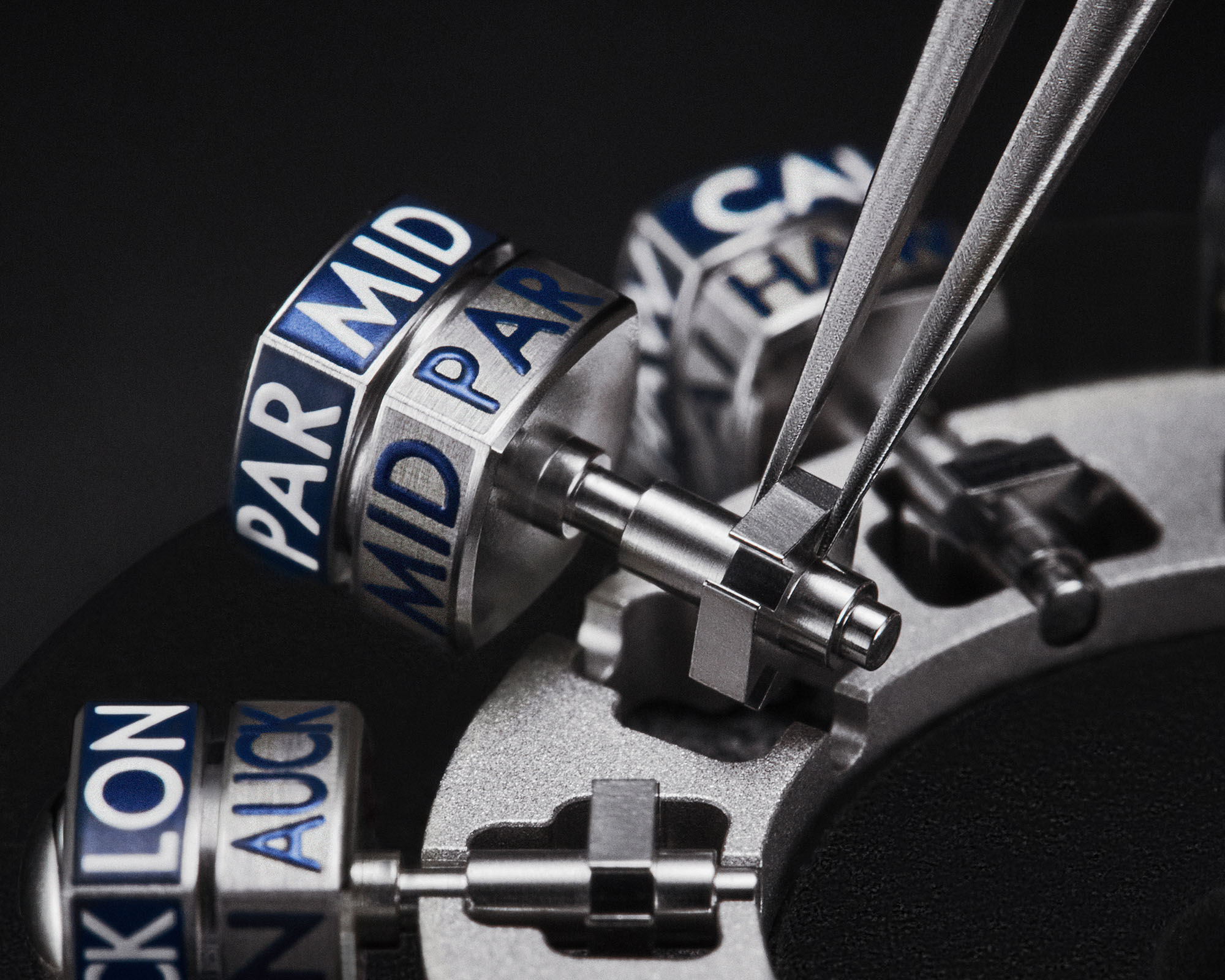
All of that is driven by the calibre ST12.01, a more complex evolution of the ST13 base that shares the same 4Hz beat and 45-hour reserve, and every adjustment — including the 24 cities — is handled through the crown. At USD 119,000 in white gold with a blue calf leather strap, the Antipode is the traveller’s pick of the collection, and it is the clearest proof that the Spin Time concept can carry a genuinely useful complication rather than just a playful one. For more on how the maison’s movement team keeps pushing in-house calibres, our Zenith Chronomaster Solo Sport write-up covers the other great in-house automatic story of the week.
Spin Time Air Flying Tourbillon: Platinum, Salmon, and a Flower-Shaped Cage
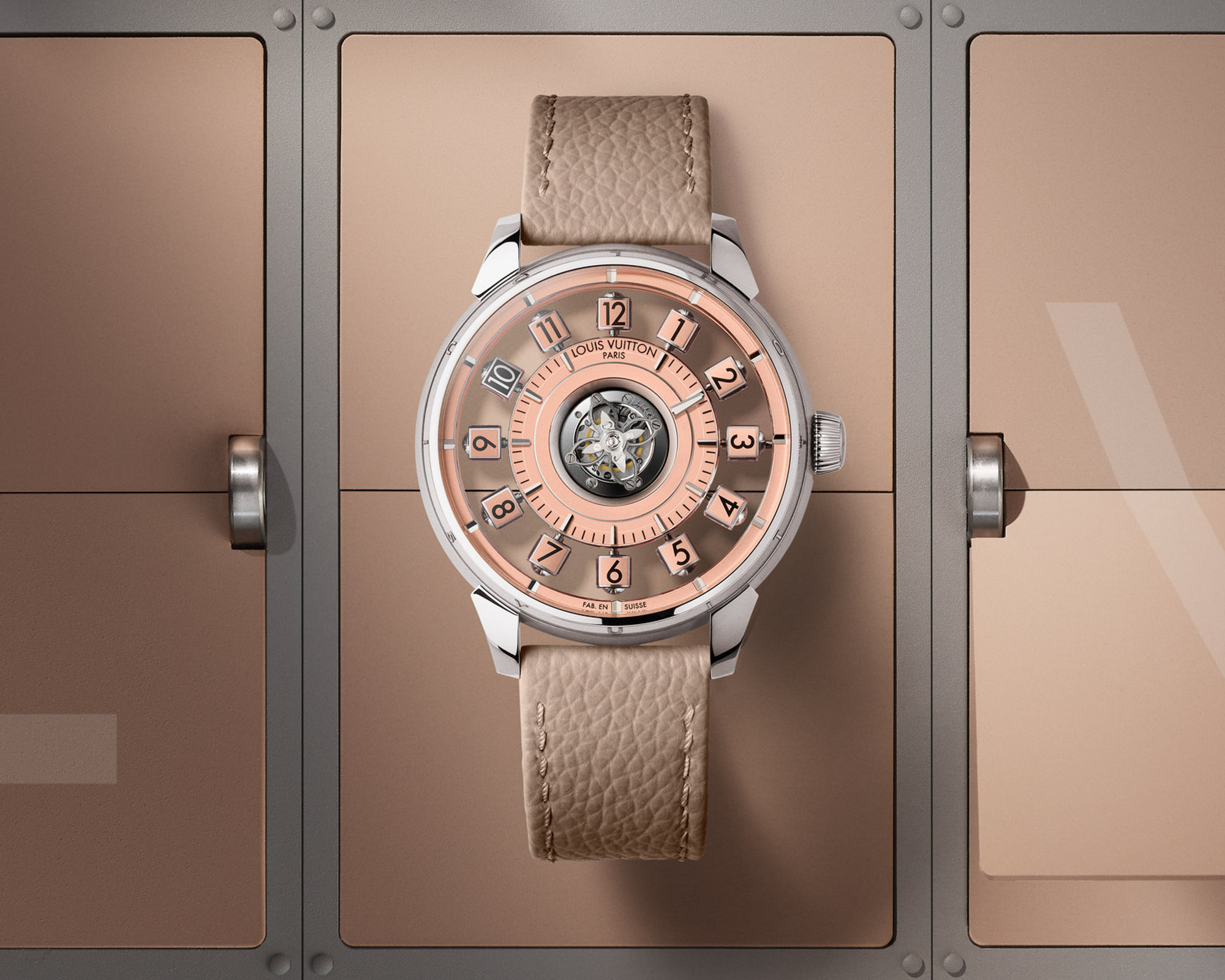
And then there is the one that makes the whole thing feel inevitable. The Tambour Spin Time Air Flying Tourbillon is the first permanent-edition Spin Time to pair the levitating cubes with a central regulating organ, and it does so in the most radical way possible: the flying tourbillon sits dead centre of the dial, with the minute hand relocated to circle the outer edge of its aperture. The cage is shaped as a Monogram flower, and the lower steel plate is polished so you can see the underside of the cage spinning above it. Louis Vuitton’s watchmakers reworked the going train entirely to make room for the regulator, and the result is a dial that reads as pure sculpture.
At 42.5mm in 950 platinum with a matte salmon dial made by La Fabrique des Cadrans, it wears the soft, discreet tone that has become a signature of high-end sports watchmaking, and it is paired with a tan calf leather strap and platinum pin buckle. The price is USD 199,000, which for a platinum central-tourbillon jumping-hour watch from a maison that owns its own movement manufacture is a statement in itself. The movement here is the calibre LFT ST05.01 — the same 4Hz, 45-hour family, but with the tourbillon integrated into the going train. It sits comfortably at the summit of this year’s tourbillon launches, up there with H. Moser’s Streamliner family in the integrated-bracelet conversation.
Specifications
| Collection | Louis Vuitton Tambour Spin Time — five permanent references (2026) |
|---|---|
| Tambour Spin Time Green reference | W9WGA2 |
| Tambour Spin Time Australia’s Opal ref. | W9PG42 |
| Spin Time Air Blue reference | W9WG81 |
| Spin Time Air Antipode reference | W9WG91 |
| Flying Tourbillon Salmon ref. | W9PT21 |
| Case | Green & Opal: 39.5mm × 12.15mm; Air models: 42.5mm × 12.45mm; white gold, rose gold (Opal), 950 platinum (Tourbillon) |
| Bezel | Sandblasted with 12 polished Louis Vuitton letters; Opal set with baguette sapphires |
| Dials | Khaki green sunray/sandblasted; Australian opal with diamond hour ring; openworked blue; Antipode world map; matte salmon snailed |
| Movements | Calibres ST13.01, ST12.01, LFT ST05.01 — in-house automatic, jumping hours, 4Hz, 45h reserve, solid gold rotor |
| Water Resistance | 100m (Green & Opal); 50m (Air models) |
| Straps | Green/blue rubber (Green & Opal); blue/tan calf leather (Air models) |
| Availability | Permanent collection, available at Louis Vuitton boutiques and louisvuitton.com |
| Prices | USD 85,500 (Green); USD 94,500 (Air Blue); USD 119,000 (Antipode); USD 189,000 (Opal); USD 199,000 (Flying Tourbillon) |
For a maison whose watchmaking division has spent a decade proving it is more than a fashion label with a movement licence, the permanent Spin Time collection is a quietly confident statement. Three in-house calibres, two case architectures, a world timer and a flying tourbillon — all built around one of the most distinctive displays in modern watchmaking, and all now part of the standing catalogue rather than a numbered run. Louis Vuitton is betting that the Spin Time’s airport-flap charm has lasting appeal, and after this morning’s presentation it is hard to argue with them. Full details and the official line-up are on louisvuitton.com, with deeper technical analysis in Monochrome Watches’ video review and aBlogtoWatch’s launch coverage.