Hölstein is a farming village of a few thousand people in the canton of Basel-Landschaft, about twenty minutes by train from Basel. It is an unlikely birthplace for one of the most stubbornly independent names in Swiss watchmaking — yet it was here, on 1 June 1904, that two entrepreneurs from Le Locle signed a contract with the local mayor and turned a shuttered factory into the Manufacture d’Horlogerie de Hölstein Christian & Cattin. Today that company is known simply as Oris, named after the Orisbach, the brook that runs beside the village and feeds into the Ergolz river.
The founders, Paul Cattin and Georges Christian, chose the site because it was cheap and the workers were available; they kept it because the strategy they built there worked. Oris was never a maison for aristocrats. It made sturdy, affordable watches for railwaymen, pilots and clerks, and it has spent the 120 years since defending that position — through the 1934 Watch Statute, the quartz crisis and the rise of the smartphone.
From Pin-Pallet Pocket Watches to a One-Million-Watch Factory
The first Oris timepieces were not wristwatches at all. They were pocket watches, built around Roskopf-style pin-pallet escapements — a simpler, cheaper alternative to the Swiss lever that let a young company sell reliable timekeeping at prices an ordinary worker could afford. The factory employed 67 people in its first year. The formula of high volume and low margins worked: by 1911 more than 300 workers were producing a watch every three seconds at peak output, and by 1914 annual production had passed one million pieces.
The growth was physical as well as industrial. A second plant opened in Holderbank in 1906, followed by a factory in Como, Italy, in 1908. Oris built housing for its workers, hired women on equal terms with men — genuinely progressive for the era — and, in 1936, opened its own dial factory in Biel/Bienne to bring production back under one roof. Sister brands such as Terma, Cinema and Lucida shared the Hölstein tooling.

Surviving the Watch Statute, the War Years and the Quartz Crisis
The interwar years brought the first serious test. Switzerland’s 1934 Watch Statute, a cartel designed to protect small manufacturers, shut larger independent firms like Oris out of the best Swiss lever escapements. Oris kept polishing its pin-pallet movements instead, and the blow of Georges Christian’s death in 1927 was absorbed by his brother-in-law Oscar Herzog, whose 43-year tenure as general manager became the backbone of the family firm.
World War II cut wristwatch output to 200,000 pieces a year under export bans, so Oris retooled for alarm clocks — 50 to 60 mm cases with central setting hands, produced in vivid colours and shapes that kept the workforce busy and remained in the catalogue for decades. After the war, the pin-pallet escapement earned its first certification from the Bureau Officiel de Contrôle de la Marche des Montres in Le Locle in 1945, followed by hundreds more.
The quartz crisis of the 1970s nearly finished the company. Oris joined the ASUAG group in 1970 and reluctantly made quartz models like the Acapulco, but sales collapsed anyway; by 1981 in-house movement production had stopped and the payroll had shrunk to a few dozen. The rescue came in 1982, when Dr. Rolf Portmann and Oscar Herzog’s son Ulrich bought the company back from the group, dropped quartz entirely and relaunched the Big Crown in mechanical form. Oris has been independent — and proudly mechanical — ever since.
1917: The First Oris Wristwatch and the Birth of the Big Crown
Oris’s first true wristwatch appeared in 1917, in the middle of the First World War: a converted pocket watch with soldered lugs and a leather bund strap, made for pilots who needed both hands on the controls. The brand’s aviation leanings went back further still — by 1911 it had already developed a pocket watch optimised for cockpit use — and the 1917 model set the template of legibility and durability that the pilot’s line still follows.
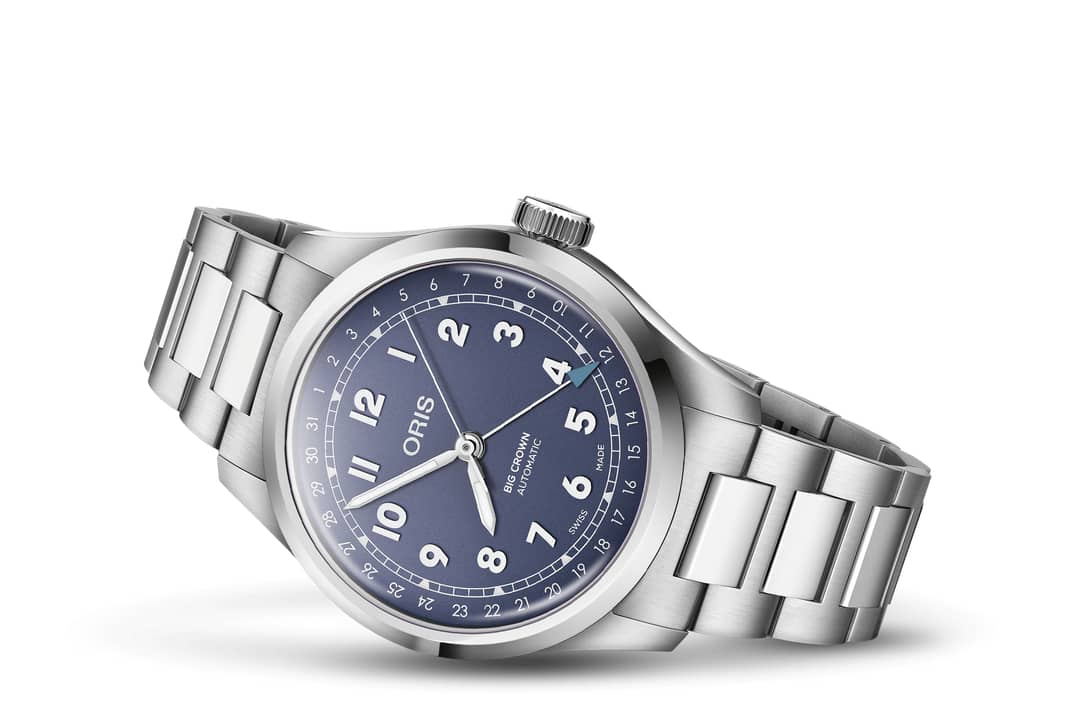
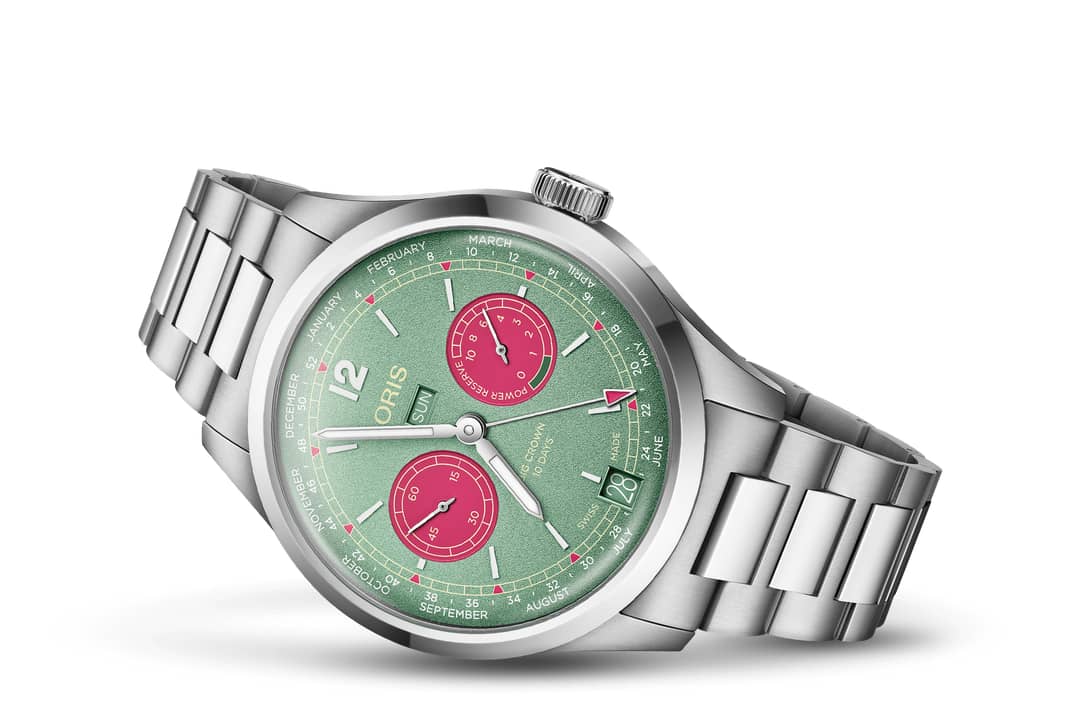
The real landmark came in 1938. Pilots flying with gloved hands needed a crown they could actually grip, and Oris answered with the Big Crown: an oversized signed crown, a black dial with gilt numerals, small seconds at six o’clock and the red-tipped pointer date that has become the model’s calling card. Built around an in-house manual movement, it remained in production through decades of reissues and today anchors the entire pilot collection.
1965 to Today: The Waterproof, the Divers Sixty-Five and the Aquis
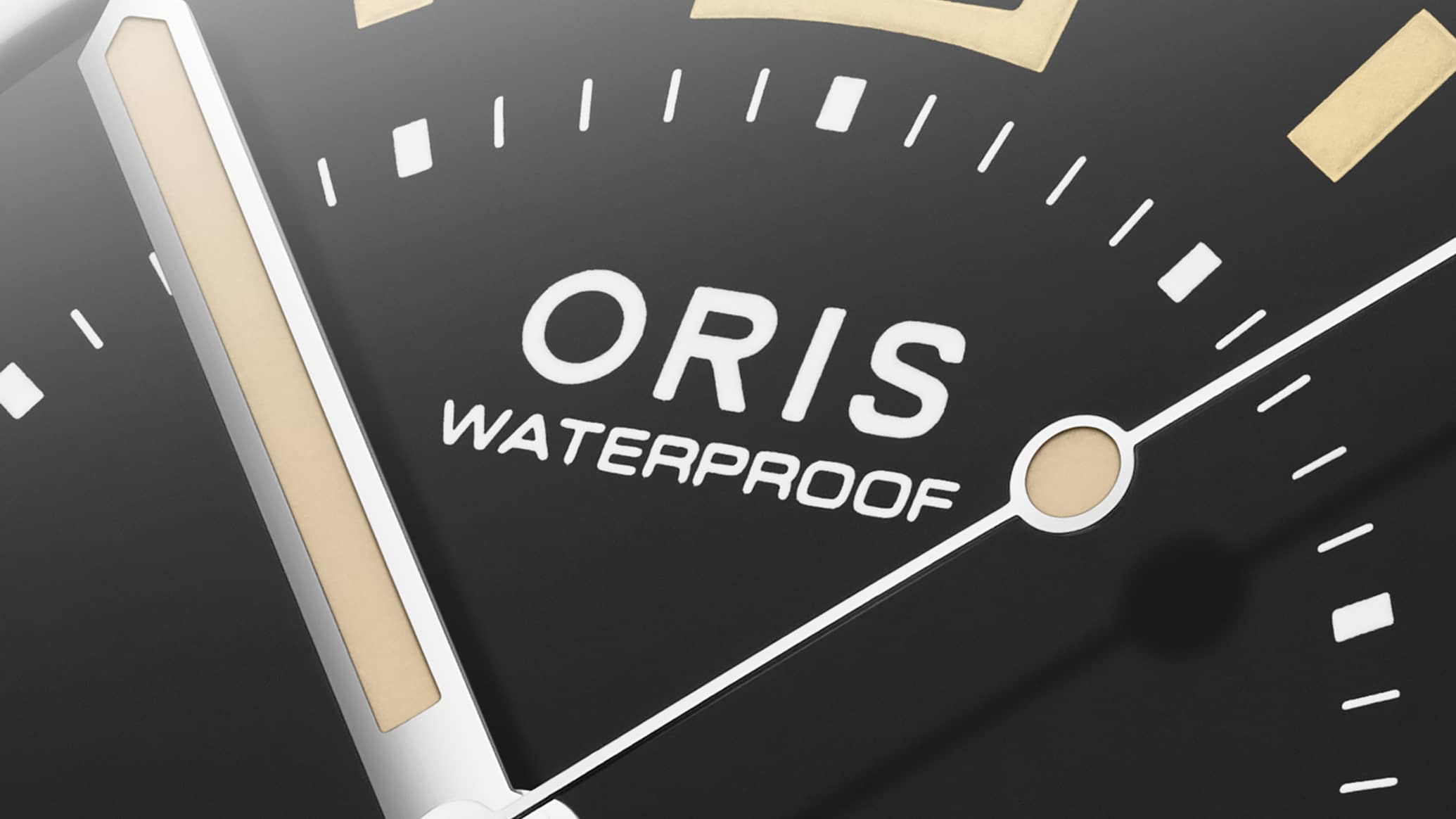
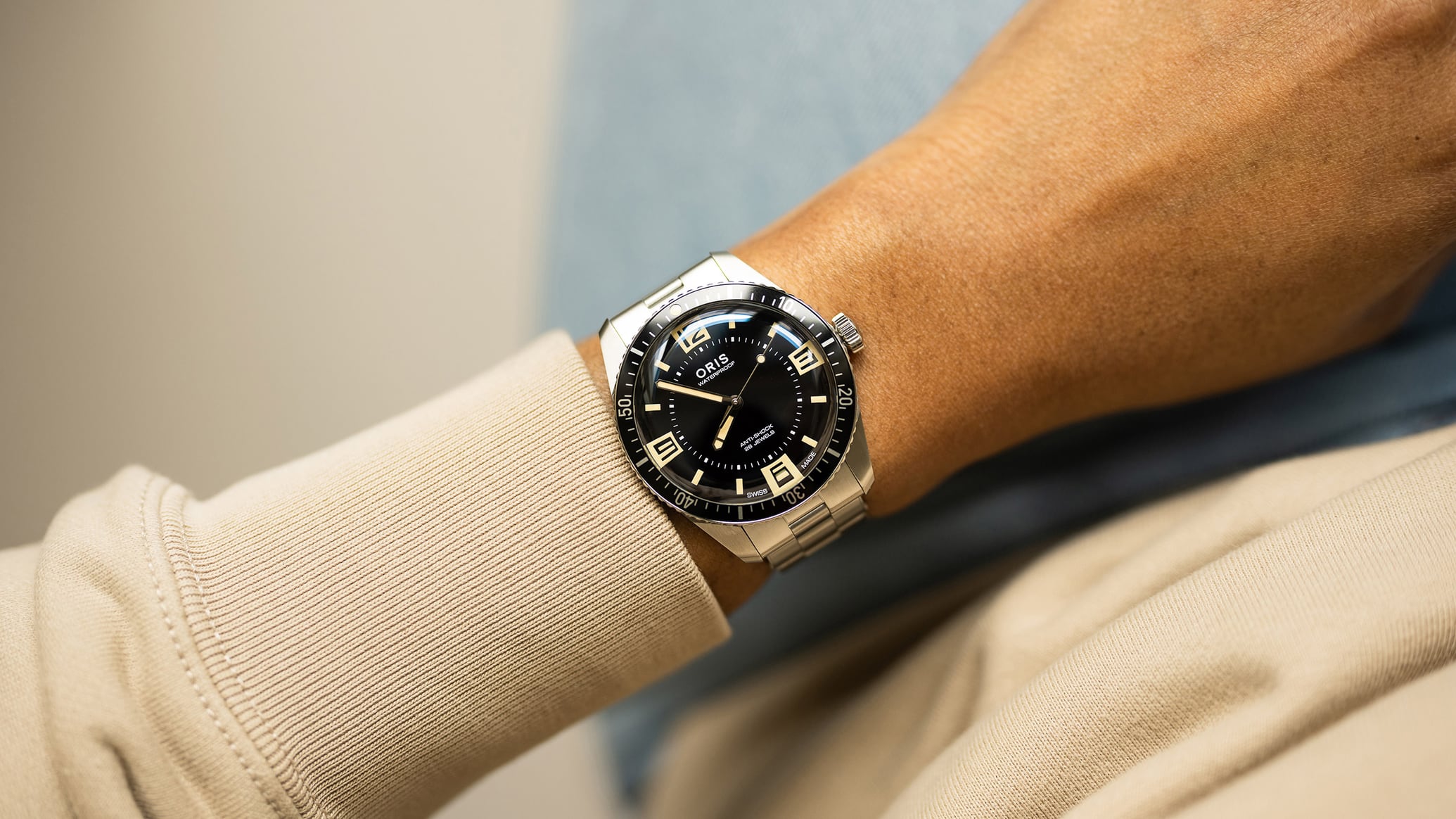
Oris went underwater in 1965 with the Waterproof, a 36 mm diver with 100 m of water resistance, a unidirectional bezel, tritium lume and the in-house Calibre 654. The 1967 Star followed with the automatic Calibre 645. The vintage formula was revived in 2015 as the Divers Sixty-Five — 42 mm steel cases, domed crystals, inverted lume plots and Calibre 733 — and it remains the most charming way into the collection.
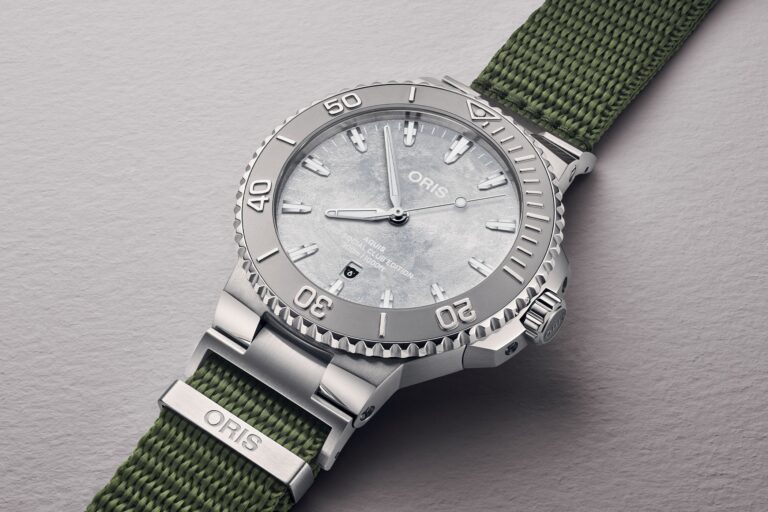
The modern diver is the Aquis, launched in 2011 with 300 m of water resistance, a screw-down crown, a unidirectional bezel and, since 2013, the Depth Gauge complication that uses water pressure to fill a coloured channel at the edge of the dial. Sizes run from 39 mm to 43.5 mm, and the top versions carry the in-house Calibre 400 with five days of power reserve, anti-magnetism to 2,250 gauss and a ten-year service interval — the anti-magnetic architecture borrowed from the aviation line’s silicon escapement work.
Calibre 400 and the Modern In-House Era
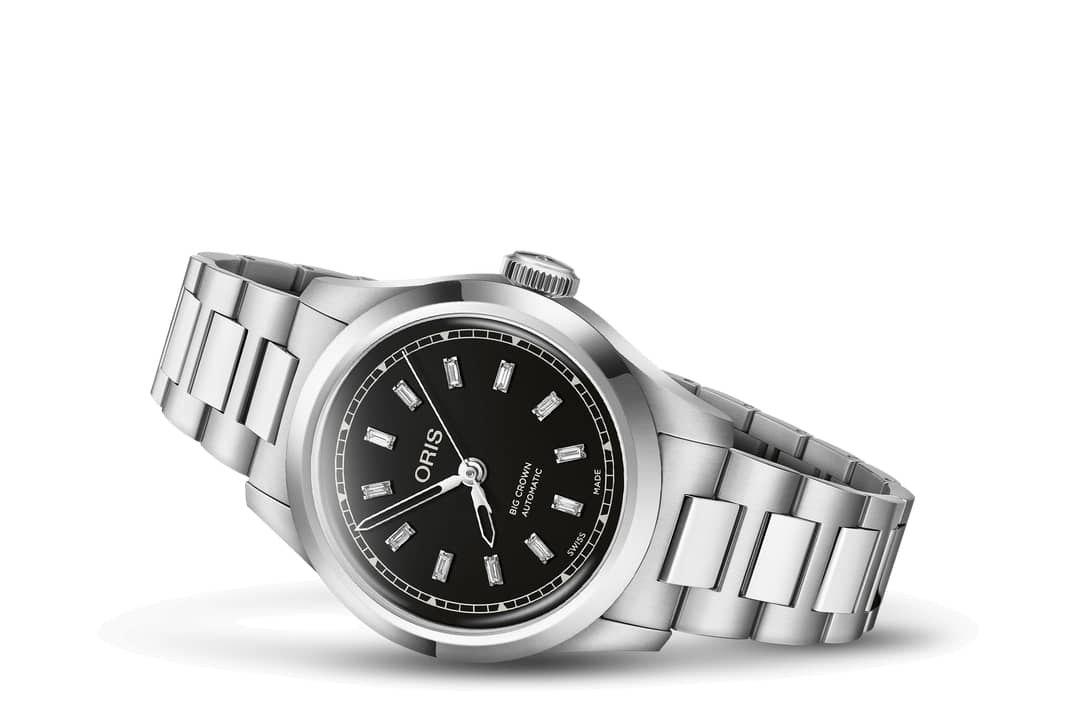
In-house movement work had stopped in 1981, and for more than three decades Oris built its reputation on dependable Sellita-based calibres. That changed in 2014 with Calibre 110, a manual movement with a ten-day power reserve introduced for the 110th anniversary, and definitively in 2020 with Calibre 400. Designed, developed and assembled in Hölstein, the 400 is a 4 Hz automatic with a five-day reserve, a silicon escape wheel and anchor, and a 10-year recommended service cycle — a deliberate statement that independence still means engineering, not just branding.
The same in-house ethos shows up across the line: the Worldtimer with its patented pusher-operated timezone correction, the ProPilot Altimeter with its mechanical air-pressure gauge, and the Calibre 115 with its ten-day reserve and visible mainspring barrel in the ProPilot X. Oris has also grown a conservation programme — limited editions for the Australian Marine Conservation Society and the Staghorn Restoration series fund coral reef work — which fits a company that has always seen itself as a toolmaker first.
Specifications: The Divers Sixty-Five in Numbers
As a measure of where the brand sits today, the standard Divers Sixty-Five (ref. 01 733 7772 4034-07 4 20 18) ships with the following:
| Reference | 01 733 7772 4034-07 4 20 18 |
|---|---|
| Case | 42 mm steel, 100 m water resistance, domed sapphire crystal |
| Movement | Oris Calibre 733, automatic, 38-hour power reserve |
| Dial | Grey-blue sunray, vintage-inspired, luminous coated hands and indices |
| Bracelet | Steel bracelet with folding clasp |
One hundred and twenty years after Cattin and Christian signed that contract beside the Orisbach, the company still makes every one of its mechanical watches in Hölstein, still refuses quartz, and still prices its best pieces below most rivals’ entry models. The village has changed around the factory; the formula has not. For that alone, Oris remains the most democratic of the Swiss independents — and the Big Crown on a gloved wrist still makes as much sense in 2026 as it did in 1938.