Arriving in Kuala Lumpur in the days before Geneva Watch Days opens its doors, the new Ming 57.05 Comet marks a quiet but meaningful moment for the young independent brand. It is the watch that closes the circle on Ming’s ninth anniversary, and it does so with a complication the maison has wanted to revisit for years. The Comet is a worldtimer, and it is, by some margin, the most accessible worldtime watch the brand has ever produced.
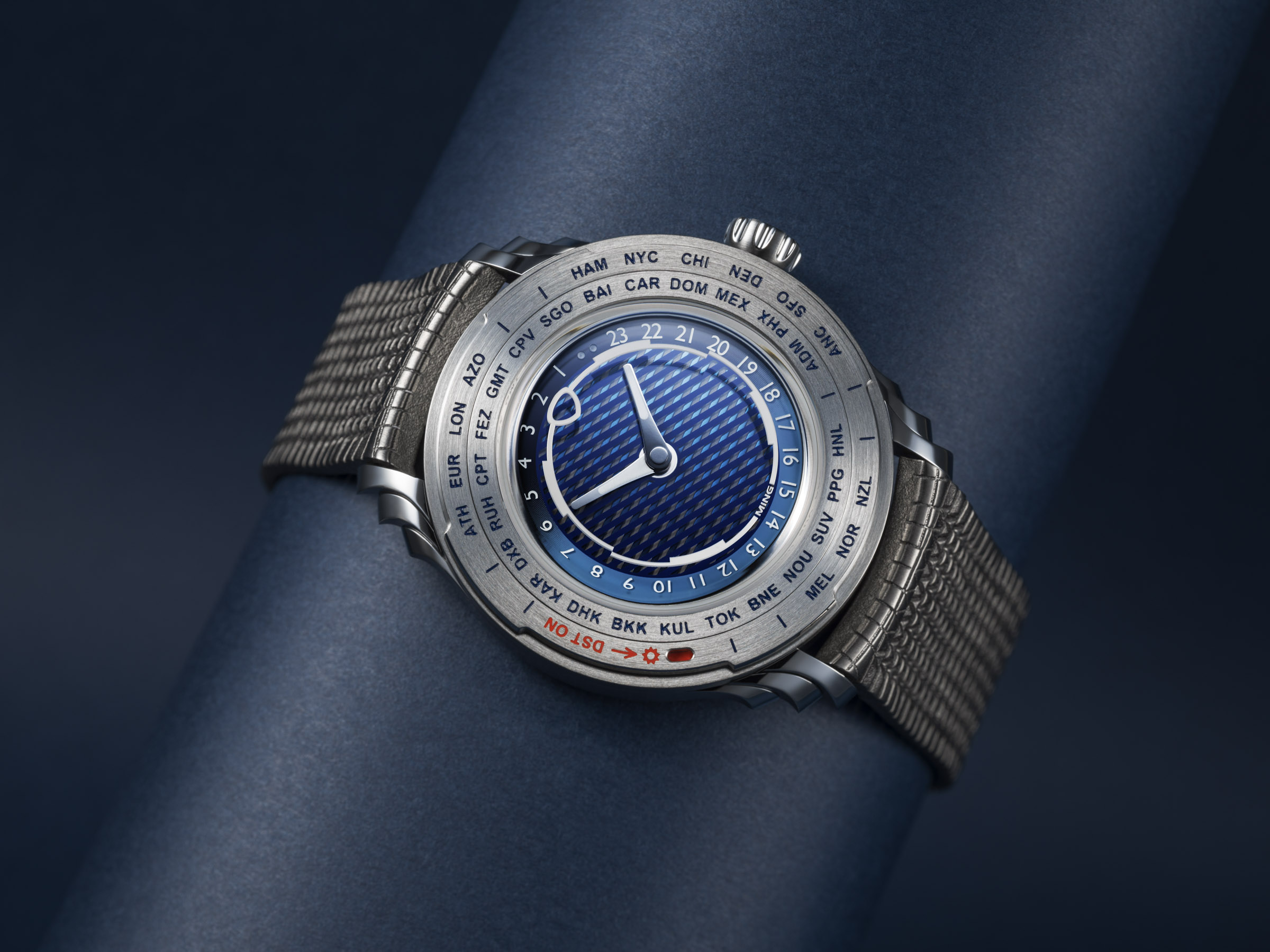
The headline act is mechanical rather than decorative. Ming’s solution to the daylight saving time problem is a two-piece bezel that, with a single click, shifts only the cities that observe DST by one hour, leaving the rest of the 24-hour ring alone. The brand describes the mechanism as patent-pending, and watching it work in the metal feels like one of those ideas so obvious in hindsight that you wonder why no one tried it sooner.
How the DST Bezel Works
On a conventional worldtimer, the 24 cities around the dial are written for standard time. When London, New York, or Paris jumps forward an hour in March, the watch obligingly lies to you for the next eight months. The Comet’s answer is a layered bezel.
Cities that do not observe daylight saving time sit on the inner bezel, fixed in place. Cities that do observe it are arranged on a separate outer ring, marked so the wearer can read them as a standalone group. Rotating the outer bezel a single indexed click, exactly 15 degrees, advances only the DST cities by one hour against the 24-hour scale. A spring-loaded ball drops into machined detents at the standard-time and DST positions, so the mechanism gives a clear tactile confirmation that you have arrived at the right setting.
A small aperture between eight and nine o’clocks tells you which mode you are in. A silver window means standard time, a red window means DST, and the red indicator glows in the dark thanks to red-emission Super-LumiNova X1. The outer bezel is notched on its perimeter so the click is easy to operate even with the watch on the wrist.
It is not a perfect solution, and Ming is honest about that. Different jurisdictions begin and end DST on different dates, and the bezel simply cannot know whether you are in week two or week ten of summer time. But for the bulk of the year, the Comet tells the truth across
all 24 cities with a single, satisfying click, and that is far more than any other production worldtimer currently manages.
A Dial That Moves
If the bezel is the brain, the dial is the personality. The centre of the 57.05 Comet carries a multilayered blue construction made of overlapping raster layers. As the inner bezel rotates through its 24-hour cycle, the relative alignment of those layers shifts, and the resulting interference pattern reveals what Ming calls the Comet Tail, a flowing, almost liquid surface that never looks the same way twice.
It is the sort of detail that only Ming seems willing to attempt. There is no guilloché, no enamel, no engraving here. The effect is achieved optically, by the geometry of the layers themselves, and the more you look at it, the more it changes. The 24-hour ring around the dial uses Super-LumiNova X1 in two colours. Daytime hours glow blue, nighttime hours glow orange, and the rotating ring keeps the wearer honest about which half of the world is currently awake.
Above the dial, the floating box-style top crystal is laser-engraved and filled with Ming’s proprietary Polar White luminous material, creating the markers for the primary 12-hour indices. The handset
carries blue-emission Super-LumiNova X1, and the DST aperture picks up the red glow at night. The luminous package is among the most ambitious in any current production watch, and it does the brand’s signature reputation no harm at all.
Fifth-Generation Case, Triple-Stepped Lugs
The 57.05 Comet sits inside Ming’s fifth-generation case architecture, the same sculptural language that debuted on last year’s 57.04 Iris chronograph. The lugs are the centrepiece of the design. No fewer than nine individual components make up a single lug assembly, and the multi-piece construction is what allows Ming to put sharply differentiated brushed and polished finishes on adjacent surfaces, something the brand argues would be impossible to achieve with conventional case construction.
The result is a watch that looks, even at 40 millimetres, more architectural than its size suggests. The triple-stepped lug profile, the polished chamfers on the case flanks, the brushed bezel, and the partly knurled, partly polished outer bezel all carry their own finish. Thickness is held to a wearable 10.33 millimetres, and the lug-to-lug length of 47.8 millimetres should sit comfortably on a wide range of wrists. Water resistance is a useful 100 metres.
Calibre, Strap, and Anniversary
Inside the case beats the Sellita for Ming 330.M2, a customised version of Sellita’s SW330 GMT architecture. It is automatic, runs at 28,800 vibrations per hour, stores roughly 50 hours of reserve, and here carries skeletonised, brushed, anthracite-coated bridges over a matching anthracite baseplate. The display back is sapphire with double-sided anti-reflective coating, and the brand’s movement finishing is more ambitious than the price tag suggests.
The Comet ships in two configurations. The first pairs the case with a cobalt blue goat leather strap by Jean Rousseau Paris, complete with curved quick-release spring bars and a flying-blade tuck buckle with micro-adjustment. The second pairs the case with the brand’s 3D-printed titanium MING Polymesh bracelet, the same remarkable mesh construction that has become one of the defining pieces of contemporary bracelet design.
Production is limited to 200 pieces, in keeping with Ming’s standard approach to numbered releases. The brand reserves the right to minor improvements before final delivery, a line that has appeared on every recent Ming specification sheet and a reminder that the maison treats each release as a small batch in its own right.
Specifications
| Reference | 57.05 Comet |
|---|---|
| Edition | 200 pieces, ninth anniversary release |
| Functions | Hours, minutes, worldtime with patent-pending DST bezel |
| Case Material | 316L stainless steel, polished and brushed, triple-step lugs |
| Case Dimensions | 40 mm diameter, 10.33 mm thickness, 47.8 mm lug-to-lug |
| Lug Width | 20 mm |
| Water Resistance | 100 metres |
| Crystal | Box-style sapphire, double-sided anti-reflective coating, top crystal engraved with MING Polar White luminous material |
| Caseback | Sapphire display back with double-sided anti-reflective coating |
| Dial | Multilayered blue Comet Tail dial with rotating 24-hour worldtime ring, Super-LumiNova X1 in blue for daytime hours and orange for nighttime hours |
| Hands | Blue-emission Super-LumiNova X1 |
| Movement | Sellita for Ming 330.M2, automatic, 25 jewels, 28,800 vph (4 Hz), 26.2 mm diameter, 4.10 mm thickness |
| Power Reserve | Approximately 50 hours |
| Movement Finishing | Skeletonised, brushed, anthracite-coated bridges over a matching anthracite-coated baseplate |
| Strap Options | Cobalt blue goat leather by Jean Rousseau Paris with flying-blade tuck buckle, or MING Polymesh in titanium |
| Warranty | 2 years against defects |
| Price (Strap) | CHF 6,950 excluding taxes |
| Price (Polymesh) | CHF 7,950 excluding taxes |
| Availability | Direct from Ming and authorised retailers from 27 August 2026, ahead of Geneva Watch Days |
Why the Comet Matters
The Ming 57.05 Comet lands in a market full of worldtimers, but it does not feel redundant. The DST bezel is the first production implementation of the idea that has been knocking around in the minds of independent watchmakers for years. Past attempts, from Bovet’s Recital 28 Prowess to Jaeger-LeCoultre’s Geophysic Universal Time, have either been visually dense or priced beyond reach. The Comet delivers a tactile, mechanical, beautifully engineered answer at a price most interested collectors can actually consider.
It is also the rare anniversary release that does not feel like a souvenir. The triple-stepped lug construction, the 100-metre water resistance, the in-house specification of the Sellita base, the layered dial, and the brand’s increasingly confident luminous execution all add up to a watch that earns its place in the catalogue rather than riding on a date. Ming has spent nine years building the credibility required to charge CHF 6,950 for a Sellita-based worldtimer, and the 57.05 Comet makes a strong case that the price is, in fact, the bargain.
For those who want to read more about the philosophical and mechanical foundation of what Ming calls the worldtime complication, our explainer on watch complications traces the broader history. Readers interested in the brand’s movement choices can also explore our guide to the key components of a mechanical watch, and for context on how independent makers are rethinking the format, the discussion of whether the tourbillon is innovation or luxury is a useful companion piece.