Omega stands as one of the most revered names in the world of luxury timepieces. From its humble beginnings in a Swiss village to becoming the official timekeeper for space missions and cinematic spies, the brand has woven a tapestry of innovation, precision, and cultural significance.
This article delves into the origins of Omega, tracing its evolution through pivotal moments, groundbreaking watches, and diverse collections that define its legacy. Whether you are a collector, enthusiast, or simply curious about horological history, the story of Omega offers timeless inspiration.
The Founding of Omega in 1848
The roots of Omega trace back to a modest workshop nestled in the Jura Mountains of Switzerland. In 1848, a 23 year old watchmaker named Louis Brandt set up shop in La Chaux de Fonds, a hub for the burgeoning Swiss watch industry.
At the time, Switzerland was emerging as a global center for precision craftsmanship, and Brandt saw an opportunity to craft high quality pocket watches using parts sourced from local artisans.
Brandt’s approach was revolutionary for its era. Rather than relying on the traditional cottage industry model where individual watchmakers assembled pieces in isolation, he introduced a division of labor system. Specialized workers focused on specific components like gears, springs, and cases, ensuring consistency and efficiency.
His early creations were key wound pocket watches, elegant round designs that appealed to the European market, particularly in England where demand for reliable timepieces was growing amid the Industrial Revolution.
By the 1870s, Brandt’s business had gained traction. He expanded operations and began exporting widely. Tragedy struck in 1879 when Louis passed away, leaving the company to his sons, Louis Paul and César.
The brothers renamed the firm Louis Brandt & Fils and relocated to Biel, a city better suited for large scale production with its access to the Biel River for powering machinery. Under their leadership, the company industrialized its processes, introducing assembly lines that foreshadowed modern manufacturing. By the late 1880s, they were producing over 100,000 watches annually, making them one of Switzerland’s largest watchmakers.
This period laid the foundation for Omega’s commitment to precision. The Brandts emphasized quality control, testing movements rigorously to meet the exacting standards of an era when accurate timekeeping was vital for railroads, navigation, and daily life.
Their pocket watches, often featuring intricate engravings and reliable mechanisms, earned a reputation for durability and affordability, setting the stage for the brand’s future triumphs.
The Birth of the Omega Name and First Watch
The pivotal moment came in 1894, a year that would immortalize the Omega name. Louis Paul and César Brandt unveiled a groundbreaking 19 ligne calibre, a movement so advanced in its design that it set new benchmarks for interchangeability and reliability.
This calibre, known internally as the Omega, was named after the Greek letter symbolizing perfection and the ultimate achievement, reflecting the brothers’ ambition to create the finest timepieces.
The Omega calibre was a marvel of engineering. It featured 17 jewels, a lever escapement, and components that could be swapped seamlessly across units, drastically reducing production errors.
Over the next two decades, it accounted for a third of the company’s output, powering pocket watches that won accolades at international exhibitions. In 1895, the firm officially adopted the Omega brand name, becoming Louis Brandt et Frère Omega Watch Co.
One of the earliest standout products was the Omega pocket chronograph from around 1900, a sophisticated tool for timing events with split second accuracy. But Omega’s innovation extended to wristwatches, a novelty at the turn of the century.
In collaboration with Audemars Piguet, they produced the world’s first minute repeating wristwatch in 1892, a delicate piece that chimed the hours on demand, now preserved in the Omega Museum in Biel.
These early wristwatches marked a shift from pocket to wearable timepieces, catering to soldiers and aviators who needed hands free functionality. The first mass produced men’s wristwatch, the Marine in 1932, further solidified this transition.
With its waterproof cork seal, it was designed for maritime use, blending ruggedness with elegance. These innovations not only boosted sales but also positioned Omega as a pioneer in adapting to modern lifestyles.
Key Innovations and Milestones in the Early 20th Century
The dawn of the 20th century brought both opportunities and challenges for Omega. Under the guidance of Paul Emile Brandt, a nephew who took the helm after the brothers’ deaths in 1903, the company expanded rapidly.
By 1910, it employed over 600 workers and produced 240,000 watches a year. Paul Emile’s vision emphasized observatory trials, competitions where watches were tested for precision under extreme conditions.
Omega’s entries consistently excelled, earning certificates that bolstered its prestige. The 1920s and 1930s were a golden age of invention. In 1925, amid economic turbulence, Omega merged with Tissot to form the Société de l’Industrie Horlogère Suisse (SSIH), pooling resources to weather the post World War I slump. This partnership allowed Omega to focus on high end models while Tissot handled more accessible lines.
Technological leaps defined the era. In 1931, Omega introduced the world’s first bidirectional automatic winding movement, harnessing the natural motion of the wearer’s arm to keep the watch powered.
The following year saw the launch of the Marine, the aforementioned waterproof wristwatch that influenced future divers’ models. By 1937, the Medicus line debuted, featuring a pulsometer scale for doctors to measure heart rates accurately, showcasing Omega’s versatility beyond mere timekeeping.
Omega’s slogan, “Omega The Sign of Excellence,” emerged from these triumphs, particularly after dominating Geneva Observatory trials in 1931. The brand’s watches became symbols of reliability, worn by professionals in medicine, aviation, and exploration.
This era also saw the introduction of the Constellation in 1952, an elegant dress watch inspired by celestial navigation, with its distinctive pie pan dial and four gold claws securing the crystal.
World Wars and Post War Revival
The world wars tested Omega’s resilience. During World War I, production shifted to military chronometers and pilot watches, with models like the 1913 ref. 141.18 featuring oversized crowns for gloved hands. The Spanish flu and economic woes in 1918 nearly crippled the industry, but Omega endured, thanks to SSIH’s diversified portfolio.
World War II brought further demands. Omega supplied chronographs to Allied forces, including the robust CK 2777 used by British commandos. Post war, the brand rebounded with renewed vigor. In 1948, to celebrate its centenary, Omega launched the Seamaster, a waterproof sports watch with an O ring gasket borrowed from submarine technology. This model, resistant to 60 meters, catered to the post war boom in leisure and adventure.
The 1950s marked explosive growth. The Speedmaster chronograph arrived in 1957, initially aimed at race car drivers with its tachymeter bezel for speed calculations. That same year, the Railmaster followed, designed for engineers with antimagnetic shielding to withstand up to 1,000 gauss fields near machinery. These watches embodied Omega’s ethos of precision under pressure, earning the brand endorsements from observatories worldwide.
By the 1960s, Omega was a household name. The De Ville collection, introduced as a separate line in 1967, offered refined dress watches for urban sophisticates, featuring clean lines and complications like moonphases.
The Quartz Crisis and Rebirth Under Swatch Group
The 1970s quartz revolution shook the mechanical watch world. Japanese brands flooded the market with affordable electronic timepieces, causing Swiss exports to plummet. Omega, like many, initially resisted but soon adapted, launching quartz models to compete. However, the crisis culminated in 1981 when SSIH faced bankruptcy.
Salvation came through a bold merger. In 1983, SSIH combined with ASUAG, another beleaguered group, to form Société de Microtechnique et d’Horlogerie (SMH). Under visionary Nicolas Hayek, SMH introduced the Swatch in 1983, a playful plastic watch that revitalized the industry. Renamed The Swatch Group in 1998, it provided Omega with resources to reclaim its mechanical heritage.
The 1990s saw a renaissance. In 1995, Omega secured a coveted role as the James Bond watch, starting with the Seamaster Diver 300M in GoldenEye. This association, continuing through Daniel Craig’s tenure, boosted visibility. Technically, 1999 brought the coaxial escapement, invented by George Daniels and refined by Omega, reducing friction for longer service intervals.
Iconic Models Speedmaster and the Moon Landing
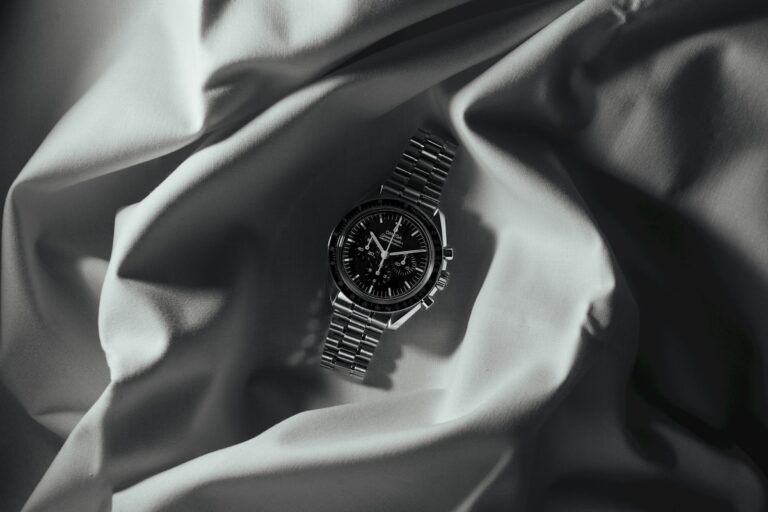
No discussion of Omega is complete without the Speedmaster, forever etched in history as the Moonwatch. Selected by NASA in 1965 after rigorous testing, it became the first watch worn on the moon during Apollo 11 in 1969.
Buzz Aldrin’s wrist bore the ref. 105.012 as he stepped onto the lunar surface, while Neil Armstrong’s served as a backup. Certified for all manned space missions since, the Speedmaster has variants like the Reduced for smaller wrists and the Skywalker X 33 for astronauts.
The Speedmaster’s legacy extends to racing and aviation, with limited editions commemorating milestones like the 24 Hours of Le Mans.
The Seamaster Legacy and James Bond Connection
The Seamaster collection epitomizes Omega’s aquatic prowess. Evolving from the 1948 original, the Seamaster 300 of 1957 offered 300 meters resistance, ideal for divers. The Ploprof in 1970 pushed boundaries with helium escape valves for saturation diving.
The Diver 300M, with its wave dial and helium valve, became synonymous with 007, appearing in Casino Royale and Spectre. Modern iterations like the Planet Ocean, launched in 2005 with 600 meters resistance, and the Ultra Deep in 2019, which reached 10,925 meters in the Challenger Deep, underscore Omega’s engineering feats.
Other Notable Collections Constellation De Ville and More
The Constellation, Omega’s oldest active line since 1952, blends astronomy with artistry. Its 1960s iterations featured the iconic “griffes” claws and pie pan dials, evolving into the Globemaster in 2015, the first Master Chronometer with METAS certification for magnetic resistance over 15,000 gauss.
De Ville represents understated luxury, with models like the Trésor featuring guilloché dials and the Tourbillon showcasing high complications. Priced from $5,000 to over $100,000, it appeals to connoisseurs.
The Aqua Terra, introduced in 2002, offers versatile sports elegance with 150 meters water resistance and teak patterned dials inspired by yacht decks. The Railmaster, revived in heritage editions, protects against magnetism for professionals.
Omega’s portfolio spans steel, gold, and titanium cases, with straps in leather, rubber, or NATO weaves. All come with a five year warranty, backed by in house movements like the Co Axial Master Chronometer series.
Modern Omega Innovations and Future
Today, under Swatch Group, Omega thrives with over 350 boutiques worldwide. It serves as official timekeeper for the Olympics since 1932 and Formula 1. Collaborations like the 2022 MoonSwatch with Swatch made luxury accessible, selling out instantly at $260.
Looking ahead, Omega invests in sustainability and silicon components for lighter, more accurate calibres. Its story, from Louis Brandt’s workshop to lunar triumphs, reminds us that true excellence endures. As Omega continues to push boundaries, it remains a beacon for those who value time’s infinite possibilities.