In the world of luxury timepieces, few brands evoke a sense of enduring elegance and pioneering precision quite like Longines. With its iconic winged hourglass logo soaring across dials for nearly two centuries, Longines has woven itself into the fabric of human achievement, from the dusty tracks of early horse races to the cockpits of legendary aviators.
Founded amid the rugged beauty of the Swiss Jura mountains, this Swiss watchmaker has not only kept time but also marked the moments that define progress. This article delves into the brand’s origins, its trailblazing path, the debut of its inaugural timepiece, and the diverse array of watches that have defined its legacy. As we trace this journey, we uncover a story of innovation, resilience, and timeless style that continues to captivate collectors and enthusiasts alike.
The Founding of Longines
The tale of Longines begins in the crisp air of Saint-Imier, a quaint village nestled in the Swiss Jura region, where watchmaking traditions ran as deep as the mountain streams. It was in 1832 that Auguste Agassiz, a visionary entrepreneur and brother to the renowned naturalist Louis Agassiz, laid the cornerstone of what would become one of Switzerland’s most revered horological houses.
Agassiz, initially a banker with a keen eye for opportunity, partnered with fellow watchmakers Henri Raiguel and Florian Morel to establish a modest workshop under the name Raiguel Jeune et Cie. The operation was humble, relying on the cottage industry model prevalent at the time, where components were crafted in artisans’ homes and assembled centrally.
Agassiz’s ambition quickly set the fledgling enterprise apart. By focusing on precision pocket watches, he tapped into a growing demand for reliable timekeeping amid the Industrial Revolution’s relentless march. However, health challenges soon prompted him to enlist the help of his nephew, Ernest Francillon, an economist with a flair for modernization.
In 1852, Francillon assumed leadership, transforming the decentralized setup into a streamlined production hub. He championed the shift from key-wound to crown-wound mechanisms, a forward-thinking move that enhanced user convenience and foreshadowed the brand’s commitment to accessibility without sacrificing quality.
The pivotal moment arrived in 1867, when Francillon inaugurated a purpose-built factory on a meadow known locally as Les Longines, meaning “long meadows” in the regional patois. This site, with its expansive fields and strategic location, symbolized a new era of centralized manufacturing.
The factory not only consolidated artisans under one roof but also introduced mechanized processes inspired by emerging American industrial techniques. Francillon’s foresight extended to branding; he engraved every timepiece with a unique serial number and the nascent winged hourglass emblem, a safeguard against counterfeits that underscored his belief in the value of authenticity.
This founding ethos of precision and protection propelled Longines forward. By 1880, following the enactment of Swiss trademark laws, Francillon formally registered the brand, securing its place in history as one of the earliest protected watch names globally. The factory in Saint-Imier has hummed continuously ever since, a testament to the enduring vision of its founders.
Agassiz and Francillon’s collaboration blended financial acumen with technical ingenuity, creating a foundation that would support Longines through wars, economic upheavals, and technological revolutions. Today, as a cornerstone of the Swatch Group since 1983, Longines honors this heritage while pushing boundaries in contemporary watchmaking.
Key Milestones in Longines Journey
Longines’ history unfolds like a well-tuned chronograph, each tick marking a leap in innovation and influence. From its early days as a supplier of sporting timers to its role as a companion to explorers and athletes, the brand has consistently timed the pulse of progress.
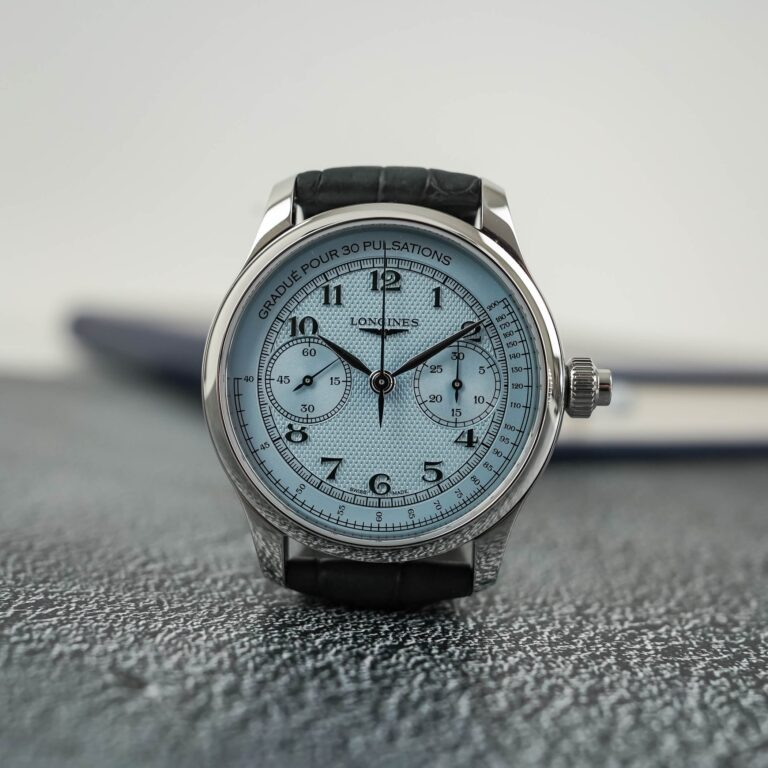
One of the earliest triumphs came in 1878, when Longines unveiled its first in-house chronograph movement, the 20H calibre. This pocket watch, etched with motifs of jockeys and steeds, found immediate favor among American horse racing enthusiasts, establishing the brand’s foothold in sports timing.
The dawn of the 20th century amplified Longines’ adventurous spirit. In 1911, the company crafted one of the world’s inaugural wrist chronographs, the calibre 19.73N, tailored for Russian pilots navigating the skies. This was no mere accessory; it embodied the precision demanded by aviation’s pioneers.
By 1912, Longines forged its first official partnership with an international equestrian event in Lisbon, igniting a century-long romance with show jumping and dressage that persists today through ties with the Fédération Equestre Internationale.
Aviation became a recurring theme in the 1920s and 1930s, as Longines collaborated with icons who redefined the possible. In 1928, the brand introduced a groundbreaking wrist chronograph with flyback functionality, allowing pilots to reset and restart timing with a single push, crucial for mid-flight calculations.
This innovation peaked in 1931 with the Lindbergh Hour Angle Watch, co-designed with aviator Charles Lindbergh after his historic solo transatlantic flight. Featuring a rotating bezel for celestial navigation, it became an indispensable tool for navigators worldwide.
The interwar years saw Longines diversify into other realms. In 1925, it developed the Zulu Time watch for the Royal Canadian Navy, the first wristwatch to display dual time zones, complete with indicators for radio silence periods. By 1933, the brand entered motorsports, timing Grand Prix races that would evolve into Formula 1.
Post-World War II, Longines revolutionized event timing with the 1949 Chronocaméra, an electromechanical system incorporating the world’s first quartz clock for sports. This device, which captured finishes to the hundredth of a second via photography, debuted at the Rallye Monte-Carlo and powered the inaugural Formula 1 season in 1950.
The 1950s and 1960s marked a golden age of expansion. Longines assumed the role of official timekeeper for the Tour de France in 1951, employing photo-finish technologies like the 1953 Chronocinégines until 1987.
In 1954, it launched the Conquest collection, its debut product line, blending sporty robustness with everyday elegance. The 1960s brought high-frequency marvels, such as the 1961 calibre 360, which triumphed at the Neuchâtel Observatory trials, and the 1967 Ultra-Chron, promising accuracy to two seconds per day.
Quartz technology arrived in 1969 with the Ultra-Quartz, outpacing mechanical rivals in precision. Yet Longines balanced innovation with tradition, timing the Commonwealth Games from 1956 onward and becoming the International Ski Federation’s partner in 2006.
The 1980s saw it chronicle every Formula 1 race from 1982 to 1992, while the 1990s repositioned the brand toward classic sophistication under Swatch Group stewardship. Recent milestones include the 2013 equestrian federation partnership and the 2020 Spirit collection, a nod to aviation roots.
Through these chapters, Longines has timed over a century of triumphs, from Amelia Earhart’s oceanic crossings to modern World Cup sprints, proving its motto: “Since 1832, elegance is an art.”
The First Longines Watch and Early Innovations
At the heart of Longines’ legacy lies its inaugural masterpiece, a timepiece that encapsulated the brand’s nascent genius. Unveiled in 1867 alongside the factory’s opening, the first official Longines watch featured the calibre 20A movement, a crown-wound pocket watch with an anchor escapement for smooth operation.
This innovation dispensed with the cumbersome key-winding systems of the era, offering users a more intuitive experience. Measuring time with newfound reliability, the 20A earned acclaim at the Universal Exhibition in Paris that same year, where it clinched an award for its craftsmanship.
The oldest surviving example, serial number 183 known as “Attesa,” bears the date October 23, 1867, and utilizes the calibre AA4, a precursor to the 20A. Crafted in 18-karat gold with intricate engravings, it reflects the artisanal finesse of Saint-Imier’s workshops. These early pieces were not mass-produced luxuries but precision instruments, often customized for discerning clients like bankers and scholars who valued accuracy in an unpredictable world.
Building on this foundation, Longines swiftly innovated. The 1878 chronograph, powered by the 20H calibre, represented a quantum leap. As a mono-pusher design controlled via the crown, it allowed seamless start, stop, and reset functions, ideal for timing equestrian events.
By the 1880s, these chronographs graced racetracks across the United States, earning endorsements from jockeys and officials alike. Longines’ technical director, Jacques David, further elevated the brand after his 1876 visit to the Philadelphia World’s Fair, where he documented American assembly-line efficiencies in a seminal 108-page report that influenced Swiss horology.
Into the 1890s, precision escalated; by 1889, movements measured intervals to a fifth of a second. The 1910 high-frequency stopwatch, beating at 36,000 vibrations per hour for tenth-second accuracy, catered to burgeoning sports like skiing.
These advancements were not isolated; they stemmed from a philosophy of miniaturization, adapting robust pocket mechanisms for the wrist era. The 1913 calibre 13.33Z, a compact 29mm chronograph, became a blueprint for aviation tools, worn by trailblazers like Earhart during her 1928 and 1932 Atlantic feats.
Early Longines watches thus bridged utility and artistry, their innovations driven by real-world demands. From the 20A’s elegant simplicity to the chronograph’s dynamic prowess, these creations laid the groundwork for a brand that would synchronize with history itself.
Evolution of Longines Watch Collections
Over nearly two centuries, Longines has curated a tapestry of collections that span from rugged adventurers to refined dress pieces, each reflecting the era’s zeitgeist while honoring mechanical mastery. The brand’s diversity stems from its dual heritage in sports timing and elegant horology, resulting in lines that cater to pilots, divers, racers, and connoisseurs.
The Conquest collection, introduced in 1954, heralded Longines’ foray into named families, blending stainless steel durability with automatic movements for the post-war jet-set. Its sporty dials and luminous markers evoked exploration, evolving into modern iterations with GMT functions for globetrotters.
A year later, in 1957, the Flagship emerged as a beacon of sophistication, its case back etched with a caravel ship symbolizing nautical heritage. Featuring slender profiles and guilloché dials, it appealed to those seeking understated luxury, with complications like moon phases in contemporary models.
Aviation enthusiasts revere the 1920s-inspired Spirit collection, launched in 2020, which revives flyback chronographs and hour-angle bezels from Lindbergh-era designs. These 40mm powerhouses, powered by silicon-balanced escapements, offer anti-magnetic resilience up to 15 times the industry standard, echoing the 1936 Weems Second Setting Watch’s radio-sync precision.
Complementing this, the Master Collection pays homage to 19th-century complications, incorporating tourbillons and retrograde displays in gold cases that whisper of observatory triumphs.
Diving into aquatic realms, the 1959 Legend Diver stands as an icon, its 42mm cushion case and bidirectional inner bezel delivering 300m water resistance. Updated with modern movements, it retains the twin-crown system for bezel adjustment, a nod to underwater pioneers. For motorsport aficionados, the 1960s-derived Heritage models feature tachymeter scales and panda dials, capturing the thrill of Grand Prix timing.
Elegance defines lines like the 1997 La Grande Classique, a razor-thin quartz or automatic piece with Roman numerals and integrated bracelets, embodying minimalist chic. The 2005 DolceVita, with its rectangular Art Deco silhouette, channels 1920s glamour, available in gold or steel with diamond accents for women. Vintage enthusiasts gravitate toward reissues like the 1918 military watch, a slim 40mm field piece with sector dials.
Throughout, Longines balances tradition with accessibility; movements range from ETA-based automatics to in-house high-beats like the L888, ensuring reliability across price points. Special editions, such as those commemorating the 1912 Olympic timing or 1982 Formula 1 partnerships, add collectible allure. This evolution underscores Longines’ versatility: from the 20H’s raw utility to the Spirit’s refined poise, each collection tells a story of adaptation, inviting wearers to script their own chapter in horological history.
As we close this exploration, Longines emerges not merely as a watchmaker but as a chronicler of aspiration. From Agassiz’s meadow factory to today’s global arenas, its winged hourglass endures, a symbol of precision that has outpaced time itself. Whether adorning a pilot’s wrist or gracing a boardroom, Longines reminds us that true elegance lies in the quiet tick of progress. For aficionados and newcomers alike, its legacy invites a closer look, one second at a time.