Longines just dropped the most compelling addition to the Master Collection in years. The brand unveiled two new complication watches on August 25, headlined by a hand-wound monopusher chronograph that marks a first for the range and accompanied by a redesigned chronograph moonphase. Both arrive with the barleycorn-pattern dials introduced earlier this year when Longines overhauled the entire Master lineup, and both carry column-wheel movements exclusive to the Saint-Imier manufacture.
I handled both pieces at the briefing, and the monopusher in particular left an impression. It is a dressy, restrained chronograph that hides genuine mechanical complexity behind a clean case profile. Longines has been making monopusher chronographs since 1911, when it produced one of the earliest purpose-built wristwatch monopushers, and that lineage shows in how polished the execution feels.
The Monopusher Takes Center Stage
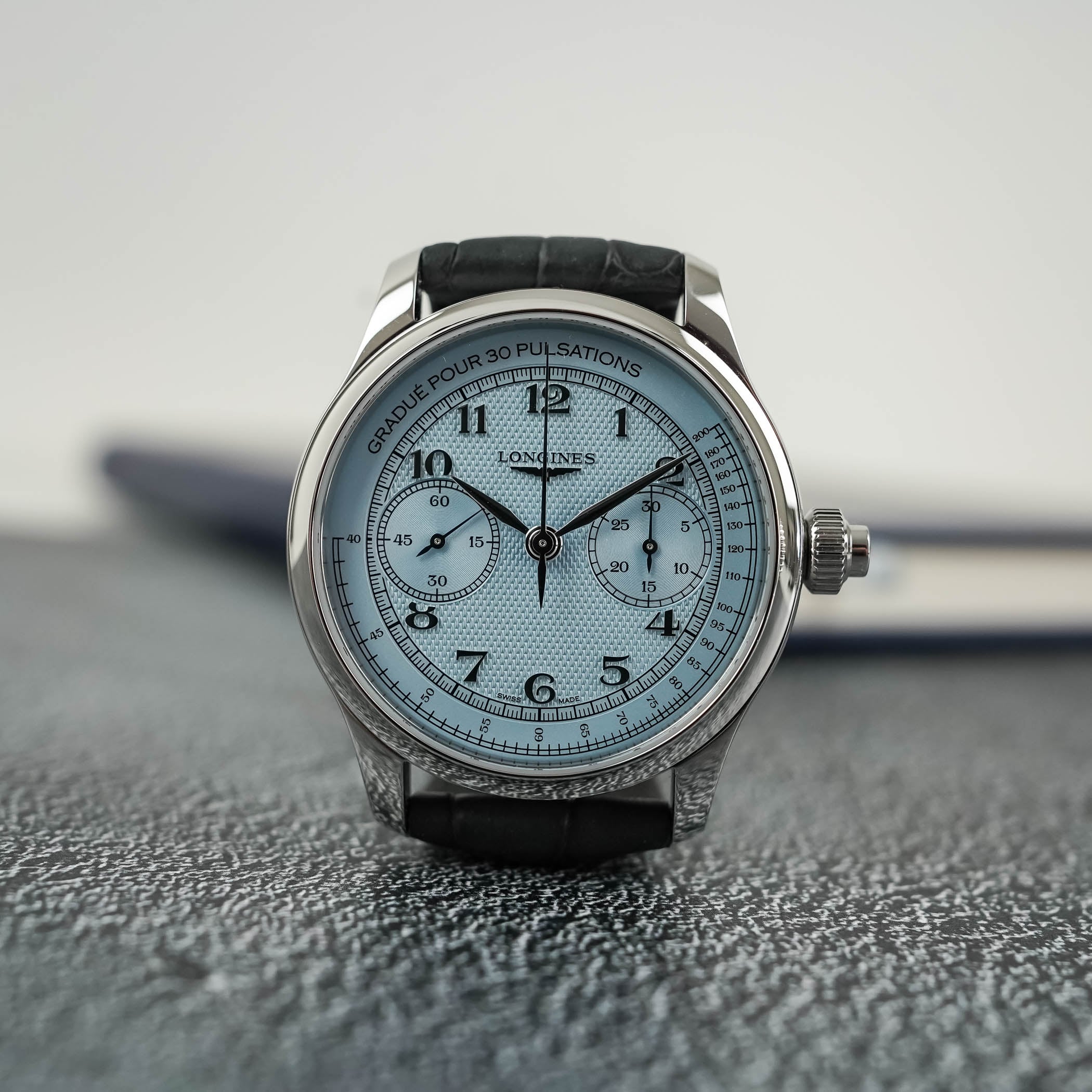
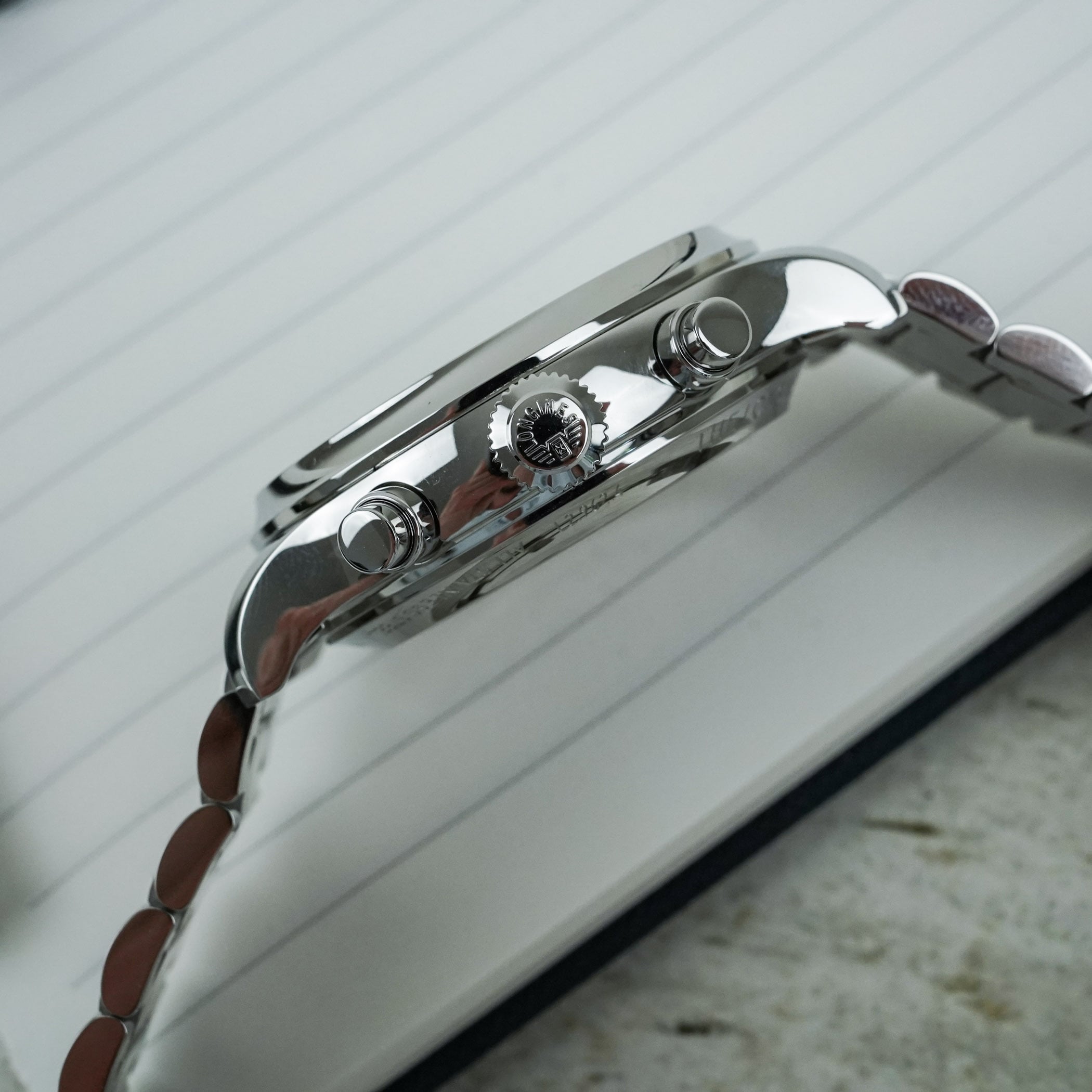
The Longines Master Chrono Monopusher arrives in a 41mm stainless steel case measuring 12.60mm thick. The height is dictated by the hand-wound calibre inside, and on the wrist the watch wears balanced rather than bulky. A polished case with a concave bezel frames the dial, and a single sapphire crystal sits up front with a display back revealing the movement.
The defining feature sits at three o’clock. The crown integrates a single pusher that handles start, stop, and reset for the chronograph. Press once to launch the central seconds hand, press again to halt it, and press a third time to zero everything. It is a deceptively simple mechanism that demands far more engineering than a standard two-pusher setup, and Longines has made it work with smooth, decisive action.
The dial carries a pulsometer scale around its outer edge, a nod to the medical chronographs Longines produced in the early twentieth century before electronic heart-rate monitors existed. Two recessed subdials at three and nine o’clock provide running seconds and chronograph minutes respectively, both finished with snailing. The barleycorn pattern in the center adds texture without clutter, and applied Arabic numerals with polished hands complete the look.
Two dial options launch the collection. The ice blue version pairs frosted blue with rhodium-plated numerals and hands, while the silver opaline option adds warmth with 5N rose gold-plated numerals and matching hands. Both feel distinctly contemporary despite the classical bones.
Behind the dial sits the calibre L799.5, a hand-wound column-wheel chronograph with a silicon balance spring. It runs at 28,800 vibrations per hour and stores 68 hours of power in a single barrel. The column wheel, finished in blued steel, is visible through the sapphire caseback alongside Geneva stripes on the top bridge, polished levers, and perlage on the mainplate. It is a clean, attractive movement that punches well above its price point.
Longines pairs the monopusher with either a brown or anthracite alligator leather strap, both secured by a new triple-folding clasp with micro-adjustment. That small pusher on the clasp lets you slide the strap a couple of millimetres in either direction, accommodating wrist swelling on warm days. It is a detail you rarely see on dress-oriented watches at this level.
The Chronograph Moonphase Gets Sharper
The second debut is the Longines Master Chronograph Moonphase, the most complex watch in the current Master range. It combines a chronograph with a full calendar, a moonphase display, and a pointer date in a single 41mm stainless steel case that measures 13.80mm thick.
Compared to the outgoing model, which came in 40mm and 42mm variants both at 14mm thick, the new version splits the difference in diameter and shaves a fraction off the height. It is a smart compromise that improves wearability without sacrificing dial real estate.
The silver dial uses the same barleycorn pattern and snailing as the monopusher, but the layout is far more elaborate. A moonphase disc with a dark blue base and gold-colored moon and stars sits inside the 12-hour chronograph counter at six o’clock. The nine o’clock subdial combines small seconds with a 24-hour indicator. At twelve o’clock, the 30-minute chronograph counter integrates day and month windows. A half-moon-tipped central hand points to the date along the outer circumference, and blued Arabic numerals with matching hands provide contrast against the silvered surface.
Despite the density of information, the dial reads clearly. Longines deserves credit for maintaining coherence across four subdials, a date track, and calendar apertures without the design tipping into chaos.
Power comes from the calibre L687.5, an automatic column-wheel chronograph built on a Longines-exclusive evolution of the Valjoux architecture. It runs at 28,800 vibrations per hour with a silicon balance spring and delivers 66 hours of power reserve. The decorated rotor features a winged hourglass cutout, and the blue column wheel is visible through the sapphire caseback alongside Geneva stripes and perlage.
Strap choices include a dark blue alligator leather or a stainless steel bracelet, both fitted with the same micro-adjustable triple-folding clasp found on the monopusher.
Specifications
| Reference | L2.960.4.93.2 ice blue / L2.960.4.78.2 silver opaline |
|---|---|
| Case | Stainless steel, 41mm diameter, 12.60mm thick |
| Crystal | Sapphire with AR coating, display caseback |
| Water Resistance | 30 meters |
| Movement | Calibre L799.5, hand-wound, column-wheel chronograph, silicon balance spring |
| Functions | Hours, minutes, running seconds, monopusher chronograph with pulsometer scale |
| Frequency | 28,800 vph (4 Hz) |
| Power Reserve | 68 hours |
| Dial | Barleycorn pattern, pulsometer scale, snailed subdials at 3 and 9 o’clock |
| Hands | Leaf-shaped with sword kink, rhodium or 5N rose gold plated |
| Strap | Brown or anthracite alligator leather, triple-folding clasp with micro-adjustment |
| Price | USD 3,900 |
Context and Positioning
These two debuts follow the June 2026 overhaul of the core Master Collection, which introduced new cases, dial patterns, hands, and bracelet options across the time-and-date automatic range. Longines has since extended ice blue dials to those three-hand models as well, pricing the 39mm version at EUR 2,500 and the 41mm at EUR 2,650. The complication watches announced today sit above those entry points, reflecting the additional mechanical complexity.
At USD 3,900, the monopusher chronograph positions itself aggressively. Hand-wound column-wheel monopushers with silicon hairsprings and 68-hour power reserves rarely appear south of USD 5,000 from Swiss competitors, and Longines has wrapped the package in a case that looks considerably more expensive than the sticker suggests.
The moonphase chronograph at USD 4,250 follows the same logic. It is Longines most mechanically complex current-production watch, and it undercuts comparable full-calendar chronographs from brands like TAG Heuer and Oris by a meaningful margin while offering a column-wheel movement and silicon components.
With these additions, the Master Collection now spans from accessible three-handers to genuinely complicated dress watches, all anchored by a cohesive design language and exclusive movements. Longines is not chasing headlines with flashy materials or avant-garde shapes. It is doing something arguably harder: building a complete, coherent collection where every piece earns its place mechanically and aesthetically.
Both the Master Chrono Monopusher and the Master Chronograph Moonphase are available now through authorized Longines retailers worldwide.