In the world of luxury timepieces, few brands evoke the thrill of precision and adventure quite like Breitling. Synonymous with the roar of jet engines and the unyielding spirit of pilots, Breitling has long transcended mere functionality to become a symbol of bold innovation and timeless craftsmanship.
Founded amid the industrial hum of late 19th-century Switzerland, this storied maison has charted a course through wars, technological revolutions, and cultural shifts, always staying true to its roots in chronometry. As we delve into the annals of Breitling’s history, we uncover not just the evolution of a brand, but a narrative of human ingenuity that continues to inspire watch enthusiasts and adventurers alike.
From its humble beginnings to its current status as a beacon of aviation heritage, Breitling’s story is one of relentless pursuit of excellence.
The Foundations of Breitling: A Vision Born in 1884
The tale of Breitling begins in the rugged Jura Mountains of Switzerland, a region etched with the legacy of watchmaking mastery. In 1884, a young Léon Breitling, just 24 years old, established his workshop in the quaint town of Saint-Imier. Born in 1860 in the nearby village of Les Ponts-de-Martel, Léon had honed his skills through a rigorous apprenticeship in La Chaux-de-Fonds, the beating heart of Swiss horology.
The timing could not have been more challenging. Switzerland’s watch industry was reeling from a severe recession, yet Léon saw opportunity in the rising demand for precision instruments. He specialized in chronographs, those intricate devices that measured time with unerring accuracy, essential for the burgeoning fields of industry, science, and sport during the Industrial Revolution.
Léon’s approach was pragmatic and forward-thinking. He adopted the traditional Swiss “Établissage” system, a decentralized model where components were sourced from specialized suppliers and assembled in-house. This method allowed for scalability without sacrificing quality.
By 1889, his ingenuity shone through with a groundbreaking patent for a simplified chronograph mechanism featuring a vertical clutch. This innovation made production more economical while maintaining reliability, setting Breitling apart from competitors who clung to more cumbersome designs. The patent, numbered CH 927, marked the brand’s first foray into what would become its hallmark: simplifying complexity without compromising precision.
As demand grew, so did the operation. In 1892, Léon relocated to La Chaux-de-Fonds, transforming his modest atelier into a full-fledged factory on Boulevard du Petit Château, later renamed Chemin de Montbrillant. This move symbolized Breitling’s ascent from artisan workshop to industrial powerhouse.
By 1899, the company bore its enduring name, L. Breitling, Montbrillant Watch Manufactory, a nod to the street that housed its heart. Early offerings were predominantly pocket chronographs, including models without minute counters for basic timing and more advanced split-seconds variants for sporting events. In 1896, Breitling even ventured into clocks with an innovative 8-day caliber, showcasing versatility beyond personal wearables.
Léon’s untimely death in 1914 at age 54 thrust the mantle upon his son, Gaston-Léon Breitling. At just 20, Gaston navigated the turbulent waters of World War I, where the demand for reliable timepieces surged. Swiss neutrality proved a boon, as factories like Breitling’s supplied both civilian and military needs, from ammunition timing to personal chronometers. Gaston’s era solidified the family’s commitment to chronograph excellence, laying the groundwork for Breitling’s future dominance in precision timing.
This foundational period was not without its trials. Economic fluctuations and the shift from pocket watches to wristwatches demanded adaptability. Yet, it was here that Breitling’s ethos took shape: a blend of technical prowess and an unyielding focus on user needs. The brand’s early watches were tools for the modern age, bridging the gap between Victorian elegance and 20th-century utility.
Pioneering Innovations: From Pocket Watches to Wrist Chronographs
Breitling’s first true icon emerged in 1907 with the “Vitesse” chronograph pocket watch. Designed to measure velocities from 15 to 250 kilometers per hour, it catered to the automobile craze sweeping Europe. A central hand completed one revolution every four minutes, allowing users to calculate speed via a patented steering wheel holder. Swiss police adopted it for issuing the nation’s inaugural speeding tickets, underscoring its practical impact. This was no mere novelty; it exemplified Breitling’s knack for translating horological skill into real-world solutions.
The transition to wristwatches came amid the exigencies of war. In 1915, under Gaston’s stewardship, Breitling unveiled its first wrist chronograph with an independent push-piece at the 2 o’clock position. This “monopusher” allowed users to start, stop, and reset the chronograph with a single button, a revelation for soldiers who needed quick, glove-friendly operation.
Though not the absolute first such design, its industrialized production marked a milestone, coinciding with the wristwatch’s rise from feminine accessory to battlefield essential. By 1910, Breitling had already produced its 100,000th timepiece, a testament to its growing stature just 26 years after inception.
Gaston’s innovations continued post-war. In 1923, he patented a system (Brevet 105532) to pause the chronograph via the 2 o’clock pusher and reset it independently with the crown. This laid the foundation for more intuitive controls. Gaston’s sudden death in 1927 at age 43 plunged the company into uncertainty during an industry crisis.
His widow, Berthe, and a board steered the ship until 1933, when 19-year-old Willy Breitling, Gaston’s son, assumed control. Willy, the third generation, proved a visionary. In 1933, he patented the modern two-pusher chronograph layout, adding a 4 o’clock button for stopping and resetting. Industrialized in 1934, this became the industry standard, influencing designs for decades.
Willy’s aviation pivot began in 1936 with the Huit Aviation division, producing cockpit instruments for the British War Office. The first aviator wrist chronograph, reference 734, appeared in the inaugural catalog. Breitling’s wartime contributions were pivotal; it supplied chronographs and altimeters to Allied forces, enduring the shortages of World War II.
Post-1945, Willy diversified with the 1941 Chronomat, a slide-rule chronograph inspired by military needs, featuring the Venus 175 movement. The 1944 Datora added a calendar complication, while the Duograph introduced split-seconds functionality.
These early wrist chronographs were Breitling’s proving ground. Robust, legible, and multifunctional, they evolved from pocket watch derivatives into purpose-built instruments. The brand’s patents and production scales not only ensured survival but positioned Breitling as a leader in horological advancement.
Milestones That Soared: Breitling’s Journey Through the Decades
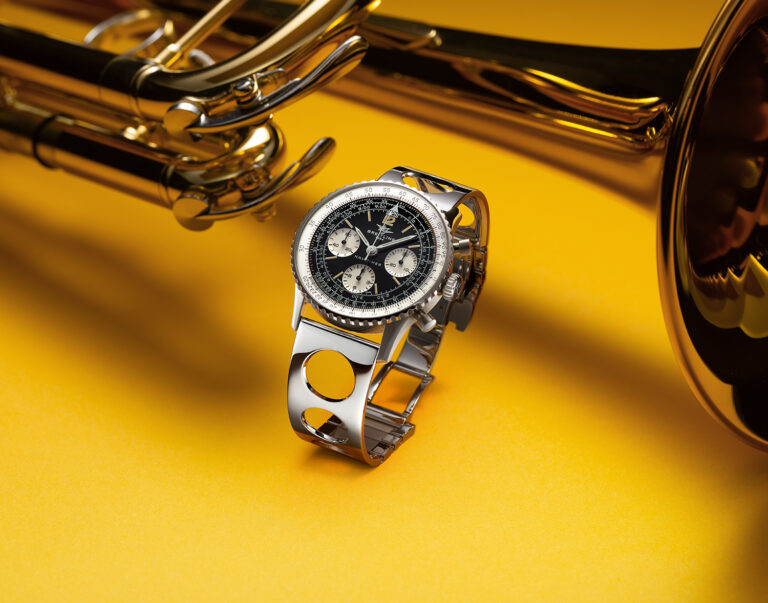
Breitling’s post-war ascent was meteoric, fueled by aviation’s golden age. In 1952, the Navitimer debuted, a circular slide-rule bezel chronograph for pilots’ navigation and timing. Derived from “navigation timer,” it became the brand’s enduring emblem, worn by astronauts like Scott Carpenter on his 1962 Aurora 7 spaceflight. The Cosmonaute variant, with a 24-hour dial, marked Breitling’s cosmic leap. By 1953, the SuperOcean diving watch entered the fray, challenging Rolex and Blancpain with its 300-meter water resistance.
The 1960s brought mechanical triumphs. In 1969, Breitling co-developed Caliber 11, the world’s first automatic chronograph, alongside Heuer, Dubois-Dépraz, and Hamilton. This self-winding marvel powered updated Navitimers and propelled Breitling into the jet age. Yet, the quartz crisis of the 1970s tested resolve.
Willy’s death in 1979 led to factory closure, but Ernst Schneider’s acquisition revived fortunes. Relocating to Grenchen, Schneider refocused on aviation, launching the 1984 Aerospace, a quartz multifunction chronograph with titanium case and SuperQuartz accuracy.
The 1990s saw diversification. The 1995 Emergency watch integrated a distress beacon on 121.5 MHz, saving lives like British pilots in Antarctica in 2003. Breitling’s sponsorships amplified its profile: the Breitling Jet Team aerobatics squad, Wingwalkers, and the 1999 Orbiter 3 balloon circumnavigation. In 2002, a partnership with Bentley Motors birthed dashboard clocks and the Breitling for Bentley collection, blending automotive luxury with horology until 2021.
The 21st century heralded in-house mastery. The 2009 B01 movement, a column-wheel chronograph with 70-hour reserve, debuted in the Chronomat 01, ending reliance on third-party calibers. Ownership shifted in 2017 to CVC Capital Partners, then Partners Group in 2022, with Alfred Gantner at the helm. Milestones like the 2013 Emergency II, adding satellite signaling, and the 2020 digital initiatives underscore Breitling’s adaptability. Through crises and conquests, these events etched Breitling’s name in the skies.
The Evolution of Breitling’s Iconic Collections
Breitling’s portfolio reflects a symphony of functionality and flair, evolving from utilitarian chronographs to sophisticated ensembles. The aviation lineage dominates, with the Navitimer family offering slide-rule bezels for dead reckoning, available in automatic and quartz variants. Sub-lines like the Navitimer B01 Chronograph embody modern refinements, while the Co-Pilot reimagines 1930s cockpit clocks for wrists.
Diving watches trace to the 1957 SuperOcean, a 1000-foot behemoth with rotating bezel and automatic movement. Revived as SuperOcean Heritage in 2007, it merges vintage aesthetics with contemporary specs, including rubber straps for aquatic pursuits. The Chronomat, born in 1942, spans dressy to sporty iterations, its rider tabs on the bezel a signature flourish.
Professional tools like the Aerospace Avantage integrate analog-digital displays for pilots, while the Chronospace Auto adds GMT functions. The Emergency series stands alone, its twin-frequency beacon a lifesaver, limited editions commemorating feats like the Orbiter flight.
Collaborations enriched variety. The Breitling for Bentley line featured Mulliner Tourbillons and B05 Unitimes, syncing with car dashboards. Ladies’ models, from 1930s elegance to modern Premier, add femininity without forsaking robustness. Across eras, Breitling’s watches prioritize COSC certification, large dials for legibility, and complications like perpetual calendars in the Skywolf.
This diversity stems from Willy’s diversification and Schneider’s revival, ensuring Breitling appeals to pilots, divers, racers, and collectors. Each collection tells a chapter of adaptation, from mechanical purity to hybrid innovations.
Breitling Today: A Legacy Reimagined
In 2025, Breitling thrives under Partners Group’s stewardship, blending heritage with innovation. The brand’s Grenchen headquarters buzzes with R&D, producing over 100,000 pieces annually, all COSC-tested. Recent releases like the Navitimer 8 and Superocean Automatic 42 refresh classics with slimmer profiles and eco-friendly materials.
Sponsorships evolve too: from Reno Air Races to modern e-sports ties, Breitling captures new horizons. Its commitment to in-house movements expands, with the B02 powering GMT functions. As CEO Georges Kern noted, Breitling honors its past while eyeing the future, a philosophy rooted in Léon’s vision.
Breitling’s legacy endures not in isolation, but in the stories it enables: a pilot’s safe return, a diver’s deep plunge, a collector’s quiet admiration. At over 140 years, it remains a testament to Swiss grit and global aspiration.