In the quiet hills of Saxony, where the Ore Mountains whisper tales of silver mines and resilient craftsmanship, a legacy of precision timekeeping has endured for nearly two centuries. Glashütte Original stands as a beacon of German horology, blending the meticulous artistry of yesteryear with the bold innovations of today.
This brand is not merely a maker of luxury watches. It is the living embodiment of a town’s unyielding spirit, forged in the fires of history and tempered by generations of skilled hands. As we trace its path from humble beginnings to global acclaim, we uncover a narrative that celebrates excellence, adaptation, and the timeless allure of mechanical mastery.
What makes Glashütte Original so captivating? It is the rare fusion of tradition and forward thinking, where every tick of the second hand echoes the footsteps of pioneers who dared to dream big in a small Saxon village. Founded amid the economic shifts of post-reunification Germany, the brand draws its soul from the cradle of German watchmaking established in 1845.
Today, as it marks milestones like the 180th anniversary of Glashütte’s horological heritage in 2025, Glashütte Original continues to craft pieces that transcend trends, appealing to collectors who value depth over dazzle. Join us on this journey through its origins, triumphs, inaugural creations, and ever-evolving lineup, revealing why this German icon remains a cornerstone of fine watchmaking.
The Origins of Glashütte Original
The story of Glashütte Original begins not in a gleaming boardroom, but in the rugged landscape of 19th-century Saxony, a region once dominated by silver mining that had begun to falter. In 1843, a visionary watchmaker named Ferdinand Adolph Lange penned a compelling letter to the Royal Saxon government, outlining a bold plan to revitalize the area through horology.
Lange, born in Dresden in 1815 and trained under the finest Parisian masters, saw potential in Glashütte’s skilled laborers, many of whom were transitioning from mining to more stable trades. His proposal struck a chord. By 1845, with royal backing in the form of low-interest loans, Lange established the first watchmaking workshop in the village, training local apprentices and laying the groundwork for what would become a horological powerhouse.
This was no isolated endeavor. Joining Lange were fellow luminaries like Moritz Grossmann, Julius Assmann, and Adolf Schneider, each bringing expertise honed in Dresden’s clockmaking circles. Together, they transformed Glashütte from a mining outpost into a nexus of precision engineering.
The government’s support was pragmatic. Saxony aimed to counter Swiss dominance in watch exports while providing employment in a depressed economy. Loans enabled the construction of modest workshops, and soon, apprentices were crafting components with unprecedented accuracy.
By the 1860s, innovations like the Glashütte three-quarter plate, gold chatons, and swan-neck regulators set these watches apart, earning them a reputation for reliability that rivaled the best from Geneva.
Yet, the path was far from smooth. The Franco-Prussian War of 1870 disrupted supply chains, and economic woes tested the fledgling industry. In response, Grossmann founded the German School of Watchmaking in 1878, securing funding from King Albert of Saxony.
This institution became the heartbeat of Glashütte’s craft, attracting talents like Alfred Helwig, who would later invent the flying tourbillon in 1920. The school emphasized hands-on training, ensuring that techniques passed down through apprenticeships remained pure and uncompromised.
The 20th century brought darker clouds. World War I drained resources, and hyperinflation in the Weimar Republic nearly bankrupted the workshops. World War II proved catastrophic. In the war’s final days, Allied bombings reduced Glashütte to rubble, destroying factories and scattering artisans. Postwar, the Iron Curtain descended. In 1949, as Germany divided, Soviet forces stripped the town of machinery as reparations, leaving a skeleton of its former self.
It was in this shadow that the direct precursor to Glashütte Original emerged. In 1951, the East German government nationalized the remaining seven watch firms, merging them into VEB Glashütter Uhrenbetriebe, or GUB.
Insulated from Western market forces, GUB focused on mechanical movements, producing reliable timepieces for domestic and Eastern Bloc needs. Models like the Spezimatic, introduced in 1964, showcased automatic winding with a self-compensating balance, a nod to Glashütte’s innovative spirit even under socialist constraints.
The turning point came with reunification in 1990. As the Berlin Wall crumbled, GUB’s remnants reemerged as Glashütter Uhrenbetrieb GmbH, a private entity with just 72 employees. Enter Heinz W. Pfeifer, a seasoned horologist who acquired the company in 1994. Pfeifer, driven by a passion to resurrect Glashütte’s glory, rebranded it Glashütte Original, appending “Original” to distinguish it from Swiss imports that had once masqueraded under the Glashütte name.
This act was both a declaration of authenticity and a homage to the town’s founders. Under Pfeifer’s guidance, and later bolstered by the Swatch Group’s acquisition in 2000, the brand rebuilt with a vow: 95 percent of components would be made in-house, honoring the in-house ethos dating back to Lange’s era.
Today, Glashütte Original operates from a state-of-the-art manufactory in the village, where the Alfred Helwig School of Watchmaking, founded in 2002, grooms the next generation. This origin story is one of rebirth, a testament to how a small town’s grit birthed a brand that now graces wrists worldwide.
Pivotal Moments in Glashütte Original’s Evolution
Glashütte Original’s journey is a tapestry of resilience, marked by events that not only shaped its identity but also redefined German watchmaking on the global stage. From the ashes of war to the boardrooms of international conglomerates, each milestone reflects an unshakeable commitment to quality amid adversity.
The 1845 founding by Lange was the spark, but the 1860s ignited the flame. In 1865, Glashütte artisans perfected the pocket watch, incorporating the three-quarter plate that minimized friction and maximized stability. This era saw exports soar, with pieces adorning the pockets of European nobility.
The 1878 school founding solidified the knowledge base, training over 1,000 apprentices by the early 1900s and fostering inventions like Helwig’s flying tourbillon, which eliminated the traditional bridge for a lighter, more elegant mechanism.
Disaster struck in 1945, when bombings obliterated 80 percent of Glashütte’s infrastructure. Undeterred, survivors like the Mühle family pivoted to precision instruments, supplying tools that aided reconstruction. The 1951 GUB merger, while politically imposed, proved a silver lining. Free from quartz threats that ravaged Swiss firms in the 1970s, GUB innovated calibers like the Spezichron in 1979, an automatic chronometer that achieved COSC certification rates far above industry norms.
Reunification in 1990 opened floodgates. With democracy came opportunity, but also competition. Pfeifer’s 1994 acquisition was pivotal, injecting capital and vision. He rebuilt the manufactory, emphasizing traditional finishes like hand-engraved balances and three-quarter plates. By 1995, the brand relaunched with mechanical watches that blended heritage with modernity, quickly gaining accolades at trade shows like Baselworld.
The 2000 Swatch Group integration was transformative. Backed by the world’s largest watch conglomerate, Glashütte Original expanded distribution to over 40 countries while retaining autonomy. This era saw investments in R&D, yielding 10 proprietary movements by the 2010s. A highlight was 2010’s Caliber 36, a self-winding powerhouse with a 100-hour power reserve, silicon components for antimagnetism, and a glucydur balance for superior accuracy.
The 2010s brought cultural milestones. In 2015, to commemorate 170 years of Glashütte watchmaking, the brand released limited editions featuring historical engravings. The COVID-19 pandemic tested resolve, yet Glashütte Original emerged stronger, launching virtual tours of its facilities in 2020 to connect with fans. Looking ahead, 2025’s 180th anniversary series will spotlight archival pieces, blending nostalgia with cutting-edge tech like aventurine dials in the PanoMaticLunar. These moments underscore a brand that thrives on evolution, turning challenges into chapters of triumph.
The Inaugural Watches That Defined the Brand
When Glashütte Original burst onto the scene in 1994, it did so with a deliberate nod to its roots, yet eyes firmly on the future. The debut collection in 1995 marked the brand’s mechanical renaissance, a lineup of wristwatches that revived GUB’s legacy while introducing fresh designs suited for a unified Germany.
At the forefront was the Senator line, the brand’s flagship from day one. The inaugural Senator Excellence, with its Caliber 36 automatic movement, encapsulated Glashütte’s ethos: a 40mm stainless steel case housing a three-quarter plate visible through a sapphire caseback, finished with perlage and sunburst patterns. Its dial, adorned with Roman numerals and blued hands, evoked 19th-century pocket watches, while silicon escapement components ensured modern precision. Priced accessibly for luxury seekers, it sold out rapidly, signaling market hunger for authentic German fare.
Complementing the Senator was the Pano debut, an asymmetric stunner with off-center sub-dials that paid homage to 1950s GUB aesthetics. The PanoMatic, the first in this series, featured a guilloché dial and date window at six o’clock, powered by the in-house 90-01 caliber with a stop-seconds function for precise time-setting. Critics praised its visual drama, a departure from symmetrical norms that highlighted Glashütte’s innovative spirit.
Not to be overlooked, the Pavonia ladies’ collection launched alongside, though with quartz movements initially to broaden appeal. The Pavonia Automatik soon followed, a 34mm gem with mother-of-pearl dials and diamond bezels, blending femininity with mechanical heart.
These first releases were more than products. They were statements of revival, limited to small runs with four-digit serial numbers capping each model at 9,999 pieces. By emphasizing 95 percent in-house production, from filigree dials to hand-assembled movements, Glashütte Original set a benchmark for transparency and craft. Early adopters, including European dignitaries, propelled the brand’s ascent, proving that heritage, when paired with innovation, resonates deeply.
A Spectrum of Timeless Collections Through the Ages
Over three decades, Glashütte Original has woven a rich mosaic of collections, each reflecting facets of its storied past while pushing horological boundaries. From elegant dress watches to rugged divers, the lineup evolves organically, drawing inspiration from Glashütte’s archives and the world’s demands.
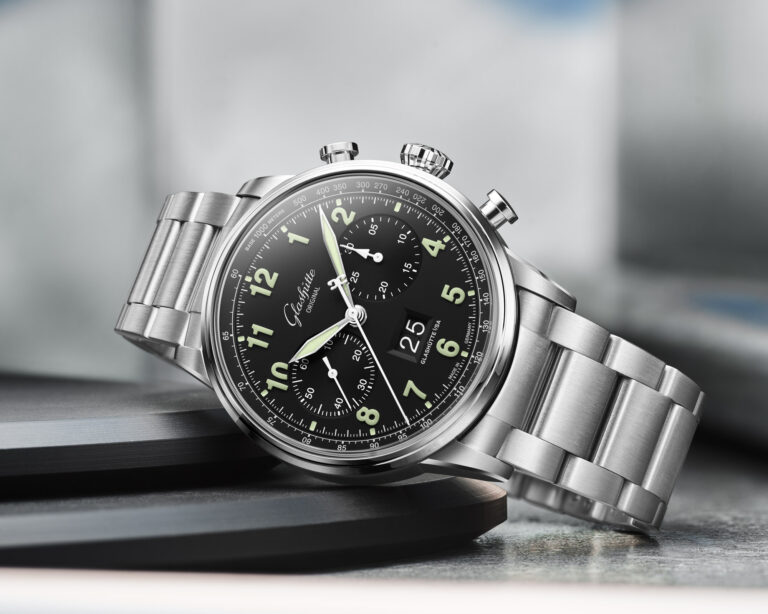
The Senator collection remains the cornerstone, a symphony of classical refinement. Evolving from 1995’s debut, it now includes the Senator Excellence Panorama Date, with its big-date complication spanning two windows for dramatic legibility. Complications abound: perpetual calendars, tourbillons, and chronographs like the Senator Chronometer, certified for chronometric precision. These pieces, often in 40mm cases with Louisiana alligator straps, embody the three-quarter plate’s legacy, appealing to boardroom sophisticates.
In contrast, the Pano collection dazzles with asymmetry, a hallmark since its 1995 inception. The PanoMaticLunar, introduced in the early 2000s, features a moonphase at eight o’clock and small seconds at four, all orbiting a central hour-minute dial. Recent iterations incorporate aventurine dials for a starry-night effect, while the PanoReserve showcases a power-reserve indicator with a patented safety feature. Sized from 40 to 42mm, Panos blend art deco flair with technical prowess, ideal for those who wear their watches as conversation starters.
For adventure seekers, the Spezialist collection, launched in 2019, channels Glashütte’s diving heritage from the 1950s GUB era. The SeaQ line, inspired by the 1969 Spezimath, offers 200m water resistance with helium escape valves and luminescent bezels. Models like the SeaQ Panorama Date integrate big-date windows into robust 39.5mm cases, powered by the 36-13 caliber. Robust yet refined, these watches nod to explorers, with titanium variants for lightweight durability.
Nostalgia finds home in the Vintage collection, reinterpreting 1960s and 1970s icons. The Seventies Panorama Date revives the Spezimatic’s vibe with a 40mm cushion case, rainbow-hued dials, and automatic movements. Limited editions, like the 2020 Sixties inspired by GUB’s Automat, feature sector dials and dauphine hands, capturing the era’s optimism in 38mm formats.
Rounding out the portfolio is the Ladies collection, formerly Pavonia, now a dedicated array of feminine elegance. From 29mm quartz pieces with diamond accents to the 37mm Automatik with floral guilloché, these watches prioritize shimmer and subtlety. The 2023 additions incorporate enamel dials and interchangeable straps, merging playfulness with precision.
Throughout, Glashütte Original’s collections share DNA: in-house calibers, Glashütte ribbing on rotors, and swan-neck regulators. Historical threads weave through, like the Spezichron’s influence on modern chronometers. With annual outputs around 10,000 pieces, rarity enhances allure. As the brand experiments with sustainable materials and smart integrations, its spectrum promises to expand, always rooted in that 1845 spark.
In reflecting on Glashütte Original’s saga, we see a brand that has weathered wars, walls, and waves of change, emerging as a pillar of integrity in luxury horology. Its watches are not just instruments of time. They are custodians of a Saxon soul, inviting us to savor the slow artistry of creation in an accelerated world. Whether you’re drawn to the Senator’s poise or the SeaQ’s grit, each piece whispers a timeless truth: true excellence endures.